
They check their phones between meds. They ask if there’s Wi-Fi. They want to know if they can finish a contract from their room. One asked if he could move his detox admission date because of a shareholder meeting.
When I first started treating high-functioning clients in our drug detox program, I had a moment of quiet disbelief.
Not because I didn’t think successful people struggled. But because I hadn’t realized how many of them were barely holding it together.
You don’t expect to find a tech CEO in detox. Or a judge. Or the owner of a construction empire. But you do. And when you talk to them long enough, the reasons are all hauntingly familiar.
They’re Tired of the Hustle, Not Just the Substance
You’d be surprised how often someone sits across from me and says, “I wasn’t trying to get high. I was just trying to keep up.”
Many of these clients didn’t start using to escape. They started using to function. To sleep when their mind wouldn’t shut off. To stay sharp through 14-hour days. To unwind without unraveling. It worked—until it didn’t.
Eventually, the balance tips. The drink that took the edge off becomes the reason they’re snapping at their staff. The pills that helped them focus become the reason they forget their kid’s birthday.
And by the time they reach us, they’re not falling apart—they’re burning out from the effort it takes to look like they’re not.
Detox Feels Like Defeat—Until It Doesn’t
High achievers hate feeling like they’ve failed. Coming to detox feels like admitting defeat. But it often becomes the first place they exhale.
We treat a lot of clients who have never stopped. Not once. Not for a weekend. Not for a breath. They’ve been in motion for years—work, home, repeat—fueling themselves with substances that promised control and delivered chaos.
So when we say, “You don’t have to hold it all right now,” there’s almost always resistance.
But then—somewhere around day two, after the worst of withdrawal softens—something shifts.
They sleep for more than four hours. They eat real food. They say something out loud they’ve never said to anyone. And in that quiet, they remember what it feels like to just be human.
That’s not defeat. That’s release.
Detox Isn’t Downtime—It’s Reentry
A lot of professionals worry detox will slow them down. They ask:
“How long will I be out?”
“Will people notice I’m gone?”
“Can I still work a little from here?”
They treat detox like a disruption. But here’s the truth: addiction is already the disruption. The missed deadlines. The irritability. The haze. The guilt. The exhaustion. That’s what’s slowing them down—not treatment.
Our job isn’t to shut them off—it’s to help them come back online without needing a substance to do it.
At Warsaw Recovery Center, detox is medical. It’s clinical. But it’s also deeply practical. We design care that understands how driven people think—without glamorizing the grind that got them here.
They Don’t Always “Look” Addicted
Here’s a hard truth: some of the most addicted people I’ve treated were also the most composed.
They weren’t belligerent. They weren’t nodding off in the lobby. They were smiling, asking good questions, dressed for a client pitch.
But their bodies told a different story—sweating, shaking, sleeping in bursts. Their minds, too—racing, restless, raw from years of internal pressure.
The world saw someone in control. We saw someone in crisis.
Addiction doesn’t always look like chaos. Sometimes it looks like a hyper-functional calendar. A spotless desk. A LinkedIn page full of wins.
You Don’t Have to Hit Bottom to Walk In
The idea that people have to “hit rock bottom” before they deserve detox? Outdated.
You don’t need to be bankrupt. Divorced. Unemployed. You don’t need to crash a car or lose your license. You don’t even need to be caught.
You just need to be tired of using something to get through every day.
We’ve admitted people who were still getting promoted. Still running companies. Still presenting at national conferences.
Success doesn’t make you immune. It just makes you better at hiding it—for a while.
What They Say When They Leave
There’s a pattern I’ve noticed over the years.
Many clients show up guarded, ashamed, minimizing. They downplay their drinking. They frame their Adderall use as “just productivity.” They say things like, “I’m probably not as bad as the others here.”
But by the end?
They say:
“I didn’t realize how much I needed this.”
“I feel like I got myself back.”
“I forgot what clarity felt like.”
They don’t leave fixed. Detox isn’t magic. But they leave clearer, softer, more honest. And most importantly—they leave wanting more than just sobriety. They want peace.
A Note to the One Still Hiding
If you’re reading this on your phone in your office, in your car, at 1 a.m. while your family sleeps—you already know something’s wrong.
You don’t need to wait for permission to take care of yourself.
You don’t have to surrender your ambition, your intelligence, or your identity to get well. You just need to stop pretending the thing you’re using isn’t using you.
That’s what detox is. A pause. A reset. A place to hand over the weight and get your footing.
FAQ: Detox for High-Functioning Professionals
Is a drug detox program different for professionals or executives?
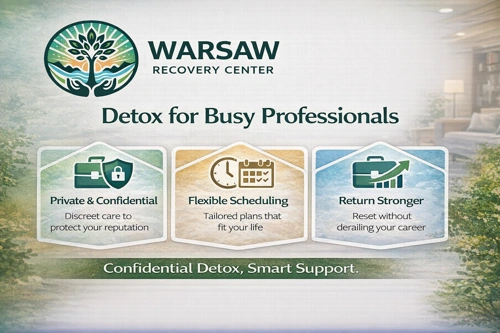
Yes and no. The core medical protocols are the same, but the support often includes privacy considerations, flexible scheduling, and staff experienced in working with driven, high-responsibility clients. At Warsaw Recovery Center, we’re used to treating people who are used to being in control.
How do I know if I really need detox?
If you’ve tried to stop and couldn’t—or if your body reacts strongly when you miss a dose or skip a drink—detox may be needed. We can assess your risk and guide you from there.
Will I be cut off from the outside world?
No. We encourage rest and limited device use during the most intense withdrawal periods, but we understand many clients have ongoing responsibilities. We’ll work with you to find the right balance.
How long will detox take?
Most detox stays last 3–7 days depending on the substance, frequency, and physical response. We’ll monitor you closely and prepare for what comes next—whether that’s extended care, outpatient treatment, or supported return to work.
What happens after detox?
That depends on you. We’ll help build a next-step plan that fits your goals, risk level, and readiness. Many professionals continue with outpatient programs that allow them to return to work while receiving clinical support.
Can I keep this private?
Absolutely. Confidentiality is not optional—it’s embedded into how we operate. We take your privacy seriously, and we’re experienced in supporting clients who can’t afford public visibility.
The Next Step Doesn’t Have to Be Public. Just Honest.
At Warsaw Recovery Center, we understand that addiction doesn’t discriminate by income, job title, or intelligence. Our drug detox program in Warsaw, VA offers medically managed care, compassionate clinicians, and space for high-functioning professionals to reset—without shame, without spectacle, and without losing who they are.
Call (888) 511-9480 or learn more about our drug detox services in Warsaw, Virginia. You’ve held everything together for so long. Let us hold this part—for just a little while.