
You don’t have to be falling apart to ask hard questions about alcohol.
Not everyone who walks into our doors at Warsaw Recovery Center has hit rock bottom. Some are still going to work. Still showing up for family. Still managing.
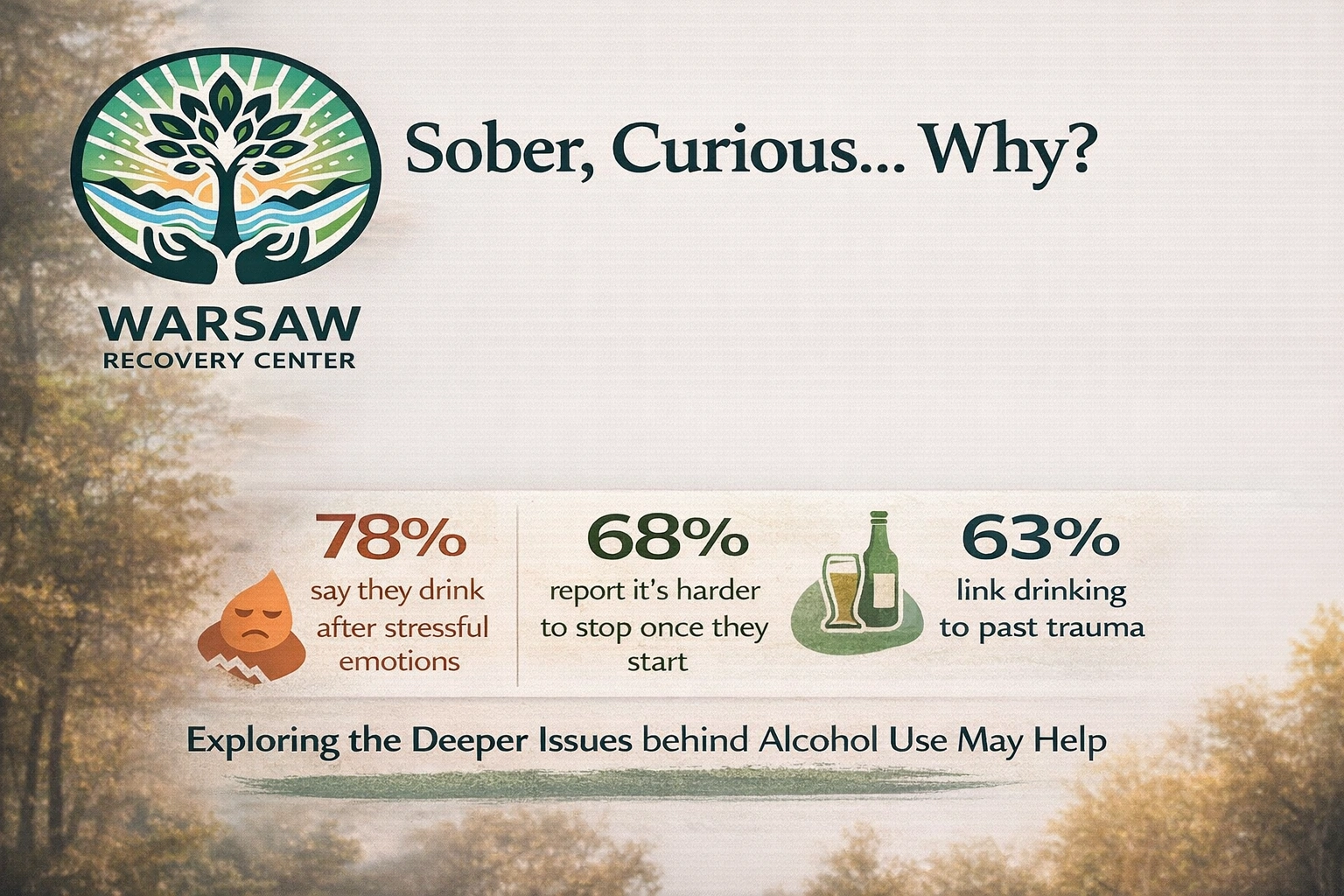
But inside, something’s off. A tension they can’t shake. Maybe they’ve started to notice that the drinking isn’t fun anymore. Or that it shows up after certain emotions hit—grief, shame, loneliness. Or that it’s harder to stop once they start.
And for many of them, what’s underneath isn’t just alcohol. It’s trauma. Old, buried, complex trauma.
This is what we walk clients through—especially those who are sober-curious and quietly wondering if something deeper is going on.
You Don’t Need a Label to Start Asking Questions
One of the first things we tell people is this: you don’t need to call yourself anything to begin this process.
We see clients from all walks of life—teachers, parents, creatives, nurses—who aren’t sure if their drinking “counts.” They haven’t lost a job. They’re not drinking every morning. But they are using alcohol to silence something inside.
And that’s enough of a reason to get curious. You don’t need to call yourself an addict or alcoholic to seek support. You just need to know that your relationship with alcohol isn’t helping anymore.
Your History Might Be Driving Your Habits
If you’ve experienced trauma—whether that’s childhood abuse, sexual trauma, emotional neglect, racial trauma, or even long-term stress—your nervous system learned how to survive it.
Sometimes that survival looks like overfunctioning. Sometimes it looks like freezing. And often, it looks like numbing.
Alcohol can become a coping strategy that works, in the beginning. It slows the racing thoughts. It dials down the panic. It adds buffer to emotional pain.
But the problem is, alcohol doesn’t just numb pain—it numbs joy, too. And over time, it begins to rob the same stability it once gave.
The Drinking Isn’t Random—It’s Patterned
A client once told us, “I only drink when I’m fine—never when I’m upset.” But when we looked closer, those “fine” days were actually days when she was avoiding something big: phone calls from a toxic parent, anniversary dates of past trauma, unprocessed grief.
The drinking didn’t follow a schedule. It followed a story.
That’s something we explore together—gently, but honestly. We ask:
- When do you feel the urge?
- What’s happening in your body right before?
- What thoughts do you notice as you reach for a drink?
Patterns don’t mean you’re failing. They mean your system is trying to protect you. And when we understand them, we can find better ways to meet those needs.
You’re Allowed to Want Clarity, Even If You’re “High-Functioning”
This one hits hard for many sober-curious clients. Especially those who’ve spent their lives proving their capability.
We hear things like:
- “I still get my work done.”
- “I never drink around my kids.”
- “I’ve cut back a lot already.”
And that may all be true. But if the emotional cost is high—if you’re drained, anxious, disconnected, or ashamed—you don’t have to wait for things to crash in order to seek help.
You’re allowed to want peace. Not just avoidance of chaos.
You’re allowed to want joy. Not just control over your triggers.
You’re allowed to want something that feels clear—not just “better than before.”
One client from Fredericksburg, Virginia shared, “I didn’t need a crisis to realize I was disappearing from my own life. I just wanted to feel real again.”
You Don’t Have to Relive Trauma to Heal From It
This is one of the biggest fears for people carrying complex trauma:
“If I stop drinking, won’t all the old stuff come rushing back?”
It’s a valid fear. Alcohol often acts as a dam, holding back memories and sensations that feel overwhelming.
But here’s what we want you to know: good trauma work doesn’t flood you. It regulates you.
You do not have to talk about everything that’s happened. You do not have to cry on command. You don’t even have to know where the pain started. You just have to be open to looking at your life now—and how it could feel less hard.
Healing trauma in recovery starts with building stability. Sleep. Food. Boundaries. Connection. Then, slowly, the deeper layers come into focus. At your pace.
Recovery Doesn’t Have to Mean Total Abstinence Right Away
You don’t have to walk in ready to quit forever.
Many of our clients are still drinking when they start. Some want to cut back. Others want to stop temporarily to get some space and perspective. Some don’t know what they want—they just know they’re tired.
That’s enough.
We don’t measure your worth by how fast you change. We focus on why the drinking started, what it’s doing now, and what your life could feel like without it.
For one client in Williamsburg, Virginia, that meant taking a 60-day pause—not to prove anything, but to learn how her body and emotions felt without alcohol’s filter. What she found surprised her: more energy, more grief, more clarity—and more motivation to keep going.
Frequently Asked Questions
Do I need to be sober to start treatment?
No. Many clients begin while still drinking. The first goal is understanding the role alcohol plays—not removing it overnight. We focus on safety, trust, and readiness—not shock or shame.
What if I don’t remember my trauma?
That’s okay. Some people carry implicit trauma—stored in the body, not in memory. You don’t need to “remember everything” to start healing. Your nervous system still tells us plenty about what needs attention.
Can I still be in control and need help?
Absolutely. In fact, some of the most emotionally exhausted people we work with are the ones who’ve been most in control—holding it all together for years. You don’t need to fall apart to deserve care.
What if therapy hasn’t helped me before?
That doesn’t mean you’re unfixable. It just means the approach might have been wrong for your needs. Trauma-informed recovery work feels different—slower, more collaborative, more focused on regulation than rehashing.
Am I allowed to just be curious—not committed?
Yes. Curiosity is a powerful start. You don’t have to walk in with a decision. You just need the courage to wonder: What if there’s something better than this?
You’re Not Broken—You’re Ready
If you’re asking yourself questions about your drinking, your past, your patterns—it’s not a sign of failure. It’s a sign of readiness.
You’re not broken. You’re just awake enough to notice that what once worked… doesn’t anymore.
And you don’t have to fix it all at once. You just have to begin.
Call 888-511-9480 or explore our alcohol addiction treatment in Richmond, Virginia to learn more. We’ll meet you right where you are—no labels, no pressure, just support for the version of you that’s ready for something more.