

You don’t drink in the mornings. You don’t crash cars. You’ve never been fired, and your kids are well cared for. So how could you possibly have a drinking problem?
If you’re high-functioning, holding it together on the outside while slowly unraveling inside—this is for you. Alcohol addiction treatment isn’t just for people who’ve hit “rock bottom.” It’s for professionals, parents, caregivers, and high achievers whose private habits don’t match their public life. And yes, Medicaid can cover that.
Explore Warsaw Recovery Center’s alcohol addiction treatment services—because seeking help isn’t failure. It’s a form of intelligence your addiction hopes you ignore.
You’re Not Falling Apart. You’re Just Tired of Holding It All Together
Let’s start with the lie: “If I were really an alcoholic, my life would look worse.”
Now the truth: Many people with alcohol use disorder keep things looking fine for years. That’s what makes it so dangerous.
High-functioning doesn’t mean healthy. It just means you’ve gotten really good at hiding the cost.
Maybe it’s waking up anxious and foggy after a bottle of wine—but still crushing your Zoom meetings. Maybe it’s wondering if your partner notices how much you “top off” your glass, or timing your refills so no one else sees.
It doesn’t have to be messy to be painful. And you don’t have to wait for a crisis to qualify for support.
Medicaid Is a Tool—Not a Label
One of the most common hang-ups we see with high-functioning clients is this: they think Medicaid-based treatment means second-rate care, or that using it means they’re “not really doing well.”
That’s stigma talking. That’s shame pretending to be logic.
Here’s what Medicaid can actually offer:
- Full or partial coverage for outpatient and intensive outpatient programs
- Access to therapy, trauma treatment, and dual-diagnosis support
- Medication-assisted options for withdrawal and cravings
- Peer support, case management, and long-term recovery planning
And if you qualify for Medicaid, using it is smart. Not desperate. Not weak. Not “those people.” Just smart.
Fredericksburg, Virginia, residents, in particular, may not realize how many high-quality treatment options are available to them under Medicaid. And you don’t need to leave your job, your kids, or your community to get help. In fact, the earlier you start, the less disruption you’ll face—and the better your outcomes tend to be.
“I’m Not Like Those Patients” Might Be Your Shame Talking
Let’s dig into that phrase—because it’s more common than you think.
We hear it in intake calls. In therapy sessions. In whispered hallway confessions:
“I’m not like the people you usually see. I haven’t lost everything. I’m still showing up.”
Yes, you are. And that’s exactly why now is the time to act.
That voice in your head that says, “You’re fine, don’t be dramatic,” is trying to keep you comfortable—but it’s also keeping you stuck.
Addiction thrives in comparison. It wants you to believe your struggle doesn’t “count” because someone else’s looks worse.
But treatment isn’t about comparing rock bottoms. It’s about protecting what you still have before it slips away.
You’ve Built a Life. Now It’s Time to Protect It.
You have a lot to lose—and that’s why you need to take this seriously.
High-functioning alcohol use disorder doesn’t come with flashing warning signs. It comes in subtle shifts:
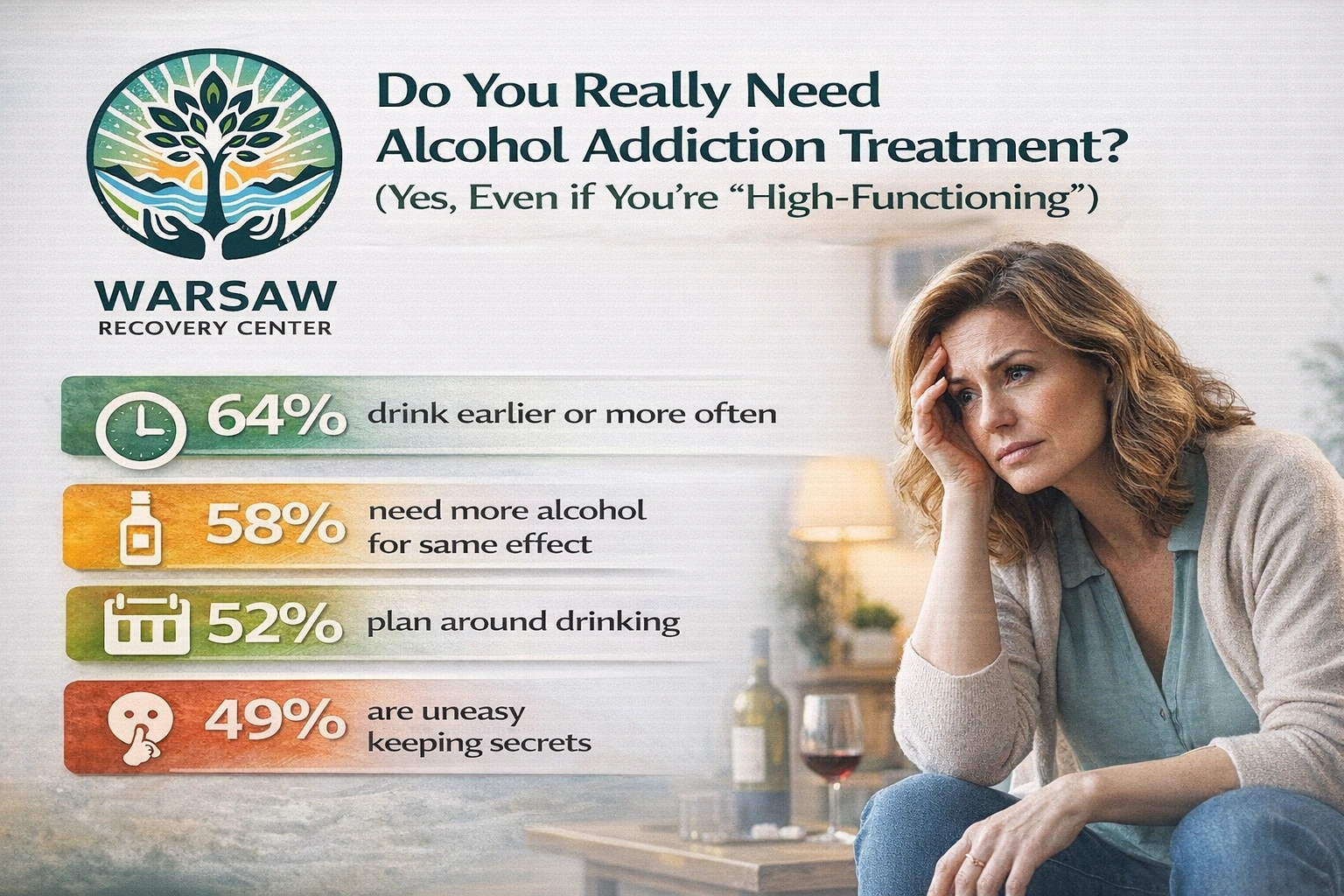
- Drinking earlier than planned, more often than planned
- Needing more alcohol to feel the same effect
- Planning social events around drinking
- Feeling uneasy, irritable, or low when sober
- Starting to keep secrets
And here’s the kicker: because nothing big has happened yet, it’s easy to dismiss those patterns. But they’re signals. And they usually escalate.
That moment when you think, “Maybe I should talk to someone,”—that’s your window. You don’t need to fall apart first. You just need to decide you’re worth more than this pattern.
Williamsburg, Virginia clients often tell us they delayed seeking help because everything still looked fine from the outside. But inside? They felt like imposters in their own lives—performing normalcy while emotionally exhausted and quietly afraid.
What Treatment Actually Looks Like (It’s Not What You Think)
Forget the movie scenes. Real alcohol addiction treatment isn’t a dramatic confession in a circle or being locked in a sterile rehab center.
At Warsaw Recovery Center, here’s what it actually looks like:
- Confidential intake with a licensed clinician who meets you where you are
- Custom treatment planning based on your actual needs—not a template
- Flexible scheduling that allows you to keep working, parenting, or caring for others
- Clinical support for co-occurring issues like anxiety, depression, trauma, or burnout
- Evidence-based care, rooted in science and delivered with compassion
Many of our clients attend outpatient or IOP (intensive outpatient programs) that blend seamlessly with their existing responsibilities. They come in before work, after school drop-off, or between meetings.
They leave more grounded. More honest. Less afraid.
There Is No Trophy for Doing It Alone
You don’t get a medal for white-knuckling your way through it. And you certainly don’t gain respect by suffering silently.
High-functioning addiction often tricks people into thinking willpower will win. But addiction isn’t a discipline problem—it’s a brain problem. And brains don’t heal through shame or self-control alone.
Real strength is knowing when to call in support.
If you’ve been holding the line for years, surviving on caffeine and apologies and “I’ll slow down soon”—let this be your pause. Let it be the moment you stop surviving and start healing.
FAQs About Alcohol Addiction Treatment (When You’re High-Functioning and Have Medicaid)
Do I really need treatment if I’m still managing my life?
Yes. Functionality doesn’t mean freedom. If alcohol is controlling your thoughts, emotions, or behaviors—and you’ve tried to cut back but can’t—that’s enough reason to explore help.
Will Medicaid actually cover real treatment—or just the basics?
Medicaid coverage varies by state, but in many cases, it fully covers outpatient, intensive outpatient, and therapeutic services. At Warsaw Recovery Center, we can help you verify your coverage and get clear on your options without pressure.
What if I’m worried people will find out?
We take confidentiality seriously. All treatment is private and protected by HIPAA laws. Your job, your family, your reputation—they don’t need to know unless you want them to.
Is treatment flexible enough for working professionals?
Yes. Outpatient and IOP programs are designed for people with jobs, families, and commitments. We offer morning and evening groups and work with you to create a plan that fits your life—not the other way around.
I’ve tried cutting back. Doesn’t that count for something?
It does. It means you want to feel better. But if cutting back hasn’t worked long-term, it’s okay to acknowledge you may need more support. That doesn’t make you weak—it makes you wise.
You Deserve More Than “Fine”
You don’t have to bottom out to rise. You don’t have to wear the label “alcoholic” to ask for relief. You don’t need to wait until someone else tells you it’s time.
If your gut is whispering that something’s off—it probably is. And you deserve the kind of support that meets your level of complexity, intelligence, and ambition. Not just a place that offers a bed. A place that offers clarity.
Let Warsaw Recovery Center be that place.
Call (888) 511-9480 to learn more about our Alcohol addiction treatment in Richmond, Virginia.
You’ve kept everything going. Isn’t it time someone helped you?