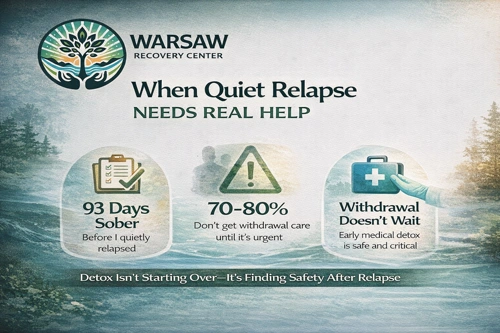
I wasn’t new. I’d done the recovery thing before—meetings, therapy, breathwork, dry January times ten. I had 93 days sober. The edges of my life were finally smoothing out. But somewhere between day 50 and day 80, I started thinking maybe I’d “overreacted.”
Maybe I wasn’t that bad.
Maybe I could drink normally now.
Maybe I just needed to loosen the reins a bit… just for tonight.
Spoiler: I couldn’t. I didn’t. And I didn’t just relapse. I relapsed quietly—the kind that doesn’t trigger alarms, the kind no one sees coming. Especially not me.
I Thought I Knew Better Than the System
After a few years in and out of programs, I had learned enough language to sound okay. I could tell people I was “struggling a little” or “in a gray area.” That was code for: I’m drinking again but I’m not ready to admit it.
The truth? I was scared. Not just scared of detox—I was scared of what it would mean to need detox again.
I told myself, “An alcohol detox program is for people who are on the edge.” Not people like me. Not someone who’d made it past 90 days once. I thought I could “self-correct.”
What I didn’t want to admit was this: I was already spiraling. Slowly. Invisibly. But it was happening.
I Minimized My Way Into a Mess
I started skipping things. First it was group. Then therapy. Then sleep. Eventually I started skipping breakfast… and people.
Because here’s the thing about drinking again after sobriety: you know what it’s doing, but you still chase it.
That knowing makes the shame cut deeper. It’s not just, “I relapsed.”
It’s, “I relapsed and I knew better.”
I convinced myself that if I didn’t hit some dramatic wall—like a DUI or a hospital stay—it didn’t “really count.” But internally, I was unraveling. And I was doing it alone.
I Didn’t Crash—I Just Disappeared
No one knew. That’s the part that haunts me. I still made the Zoom meetings, cameras off. I still texted “I’m good” when people checked in. I smiled when I saw old friends. But I was lying through my teeth.
And that’s the kind of relapse that really gets you. The one you hide so well, even you start believing it’s manageable.
Until one night, I woke up sweating, shaking, and certain I couldn’t make it to work. I hadn’t eaten in 36 hours. I was wired and exhausted. My heart was racing. My mind was spinning. I thought it was anxiety. It wasn’t.
It was withdrawal.
Withdrawal Doesn’t Always Look Like the Movies
I didn’t have seizures or hallucinations. But my body was revolting. The anxiety. The nausea. The insides-on-fire feeling. It wasn’t just nerves. It was my central nervous system screaming, “What are you doing to us?”
That was the moment I stopped pretending. I needed help. Not just to stop drinking—but to do it safely.
I remembered hearing someone say once:
“Detox isn’t about weakness. It’s about not dying.”
That stuck. I called a friend. Then I called a program.
I Finally Said Yes to an Alcohol Detox Program
This wasn’t some dramatic Hollywood detox scene. It was a clean, quiet place with staff who didn’t flinch when I told them I’d relapsed.
They didn’t make me start over. They didn’t make me explain why I didn’t come in sooner.
They said, “You’re here. That’s enough.”
And that broke me in the best way.
Programs like Warsaw Recovery Center’s alcohol detox services don’t ask you to prove you’re “sick enough.” If your body is dependent on alcohol—even mildly—you deserve medical support while coming off it.
The thing I avoided turned out to be the thing that saved me. Again.
What Detox Gave Me That I Couldn’t Give Myself
- A quiet space to stabilize
- Medical oversight for withdrawal
- Staff who reminded me I’m still worth helping
- Time—real, uninterrupted time—to remember why I got sober in the first place
And when my head started to clear, the shame lifted just a little. Because I wasn’t starting over. I was picking up the thread I’d dropped. And that’s different.
Relapse Doesn’t Erase Everything
This part is important.
If you’ve relapsed—quietly, catastrophically, or somewhere in between—you didn’t ruin everything. You didn’t reset the clock of your worth. You didn’t become a “failure.”
You’re still someone who fought like hell for recovery. And you can still fight again. Detox doesn’t make you a beginner. It helps you re-enter your own life.
Whether you’ve been to treatment before or this is your first time, alcohol detox programs in Virginia are there to keep your body safe while your spirit recalibrates.
Don’t wait until you crash. Reach out the moment you think you might need to.
FAQs: Alcohol Detox After a Relapse
Do I really need detox if I only relapsed for a few weeks?
If you’ve been drinking regularly—even for a short time—and are experiencing any symptoms when you stop (shaking, insomnia, anxiety, nausea), you might need medical detox. It’s not about how long you relapsed. It’s about how your body is responding.
Will detox make me feel like I’m starting over?
Emotionally, it might. But logistically, no. Detox is stabilization—not rehab. You’re not back at day one of your life. You’re making a smart decision to interrupt a slide before it becomes a cliff.
What if I’m embarrassed to go back to treatment?
Everyone is. Seriously. The bravest people I’ve met are the ones who walked back in anyway. Places like Warsaw Recovery Center understand relapse. They won’t shame you. They’ll support you.
Can I use Medicaid or insurance for detox?
Most likely, yes. Warsaw Recovery Center accepts many forms of insurance and can walk you through eligibility for their detox program in Virginia. It’s okay if you’re unsure—just call and ask.
This Time, I Let It Be Different
If I could go back, I wouldn’t change the relapse—I’d change how long I waited to ask for help.
Because I know now: Coming back isn’t weak. It’s sacred. It’s the kind of strength you earn by surviving what tried to break you.
So if you’re standing at that edge, wondering if you really need detox—call. Ask. Let someone hear your voice. And let them remind you that you still matter. You still get to come home to yourself.
Call (888) 511-9480 to learn more about our alcohol detox program services in Warsaw, Virginia. Whether it’s your first time or your fifteenth attempt, we’ll meet you without judgment—and walk with you from there.