
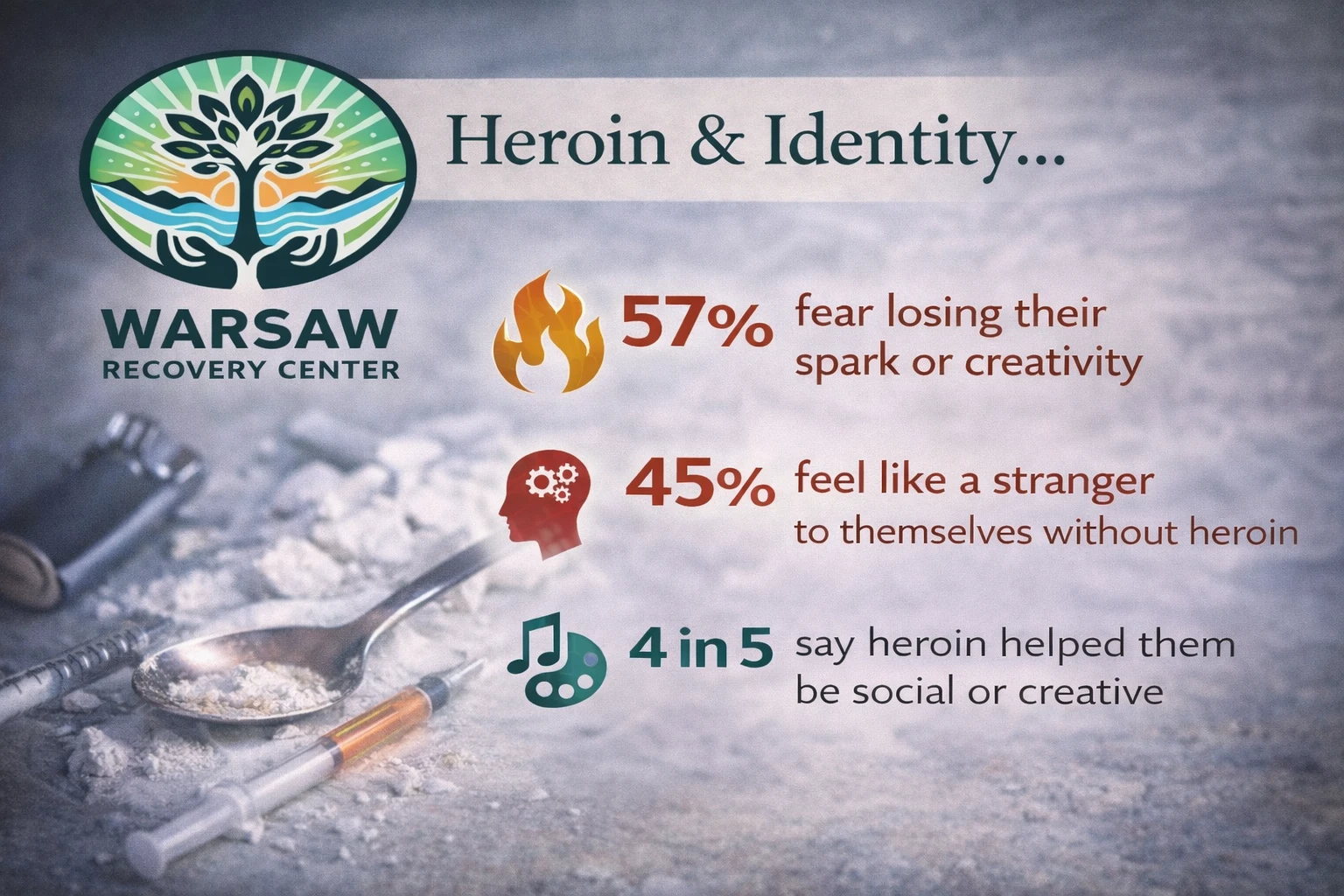
There’s a quiet fear that lives beneath the surface for some people who use heroin—not just the fear of withdrawal or consequences, but the fear of becoming someone else entirely if they stop.
Not a worse version of themselves, necessarily. Just… unfamiliar. A stranger in the mirror.
At Warsaw Recovery Center, we’ve walked with artists, musicians, social butterflies, deep feelers, and charismatic leaders—people whose whole identity felt intertwined with heroin. And many of them were terrified that sobriety meant losing everything that made them them.
Let’s talk about that fear, gently and truthfully.
“Heroin Made Me Feel Like Me”
People often assume heroin is used to escape. And sometimes that’s true. But for many creatives, it didn’t start there. It started with connection. Openness. Energy.
Heroin can feel like a shortcut to everything that usually takes emotional work—comfort, confidence, vulnerability, even transcendence. For someone sensitive and imaginative, that shortcut can be hard to give up.
You might think:
- “It’s the only time I don’t overthink everything.”
- “I’m more me when I use.”
- “Without it, I don’t know if there’s anything left.”
But what if that version of you—the one who shines, who feels, who creates—isn’t inside the heroin? What if it’s been yours all along?
The Fear of Losing Your Spark
There’s a particular ache that shows up in recovery for people who identify with their charisma, creativity, or emotional depth.
They’re not afraid of detox.
They’re afraid of becoming flat. Generic. Disconnected.
Maybe you’ve seen sober people who seem lifeless, and you’ve thought: Is that going to be me?
Or maybe you fear that people will stop paying attention once you don’t have that edge. That you’ll fade out of the friend group. That your creativity will dry up.
These are real fears. And they’re not silly. They’re deeply human.
What We See—And What We’ve Lived
Many of our clients have said the same thing:
“I thought heroin gave me something. Turns out it was taking pieces of me I didn’t even notice at first.”
One woman from Fredericksburg, Virginia came to us after years of hiding her heroin use under a mask of energy and charm. In her words, she was “the fun one, the wild one, the one everyone called when they wanted a good night.”
She was terrified recovery would make her boring. That she’d lose her magnetism.
But six months into treatment, she started painting again. Sober. Fully present. Her first piece? A portrait of herself—not as she looked in addiction, but as she felt stepping out of it: clear-eyed, still wild, and beautifully real.
Recovery didn’t steal her spark. It cleared the smoke so she could see it again.
Boring? Or Finally Safe?
Let’s name something hard: safety can feel boring when you’ve lived in chaos.
The adrenaline of hiding. The edge of risk. The unpredictability of each day—it all creates a kind of intensity that’s easy to mistake for depth.
So when things get calm? Regulated? Predictable?
It can feel like something’s been taken away.
But what if safety isn’t a flattening? What if it’s a foundation?
When the fight-or-flight stops, your nervous system gets a chance to rest. And that rest gives rise to freedom—the kind that lets you explore new sides of yourself without needing to brace for collapse.
What Creativity Looks Like in Recovery
A lot of people fear that heroin was the key to their creative fire. That without it, the words won’t come. The brush won’t move. The stage won’t call.
But here’s what we’ve seen in so many clients:
- The emotions didn’t go away—they just stopped hijacking your process.
- The imagination didn’t dull—it found space to stretch.
- The vulnerability didn’t vanish—it became safe to explore.
One client from Williamsburg, Virginia, a writer and spoken word performer, told us,
“Heroin didn’t make me a better artist. It made me a more urgent one. But urgency isn’t the same as depth. I finally have room to write without bleeding.”
In recovery, creativity doesn’t get smaller. It gets cleaner. More intentional. More sustainable. And sometimes, more powerful.
You Don’t Have to Trade Identity for Sobriety
This is important. Maybe the most important part.
Recovery isn’t about turning you into a cookie-cutter version of a “sober person.” It’s not a mold you have to fit. It’s not a set of rules designed to shrink you.
It’s a process of excavation, not erasure.
Of rediscovery, not redesign.
You get to decide what parts of you come with you into this next chapter. And you get to leave behind anything that was never truly yours.
At Warsaw Recovery Center, we don’t believe in one-size-fits-all treatment. We honor the you you want to keep—and help you find the parts you thought were gone.
Frequently Asked Questions
Does sobriety really change your personality?
Not in the way most people fear. Sobriety doesn’t take away your personality—it takes away the distortions. If substances were masking your anxiety or inflating your energy, there may be a shift. But the core of who you are is still there. And most people find that clarity lets them access deeper, more stable versions of their humor, creativity, and connection.
Can I still be creative without heroin?
Yes—often more so. Many people report that their creative flow returns more consistently in recovery. Without the physical and emotional ups and downs of use, your brain has more space to focus, imagine, and express. You may also find that your work becomes more emotionally resonant and meaningful.
What if I don’t recognize myself in recovery?
That’s a normal fear. But it’s not a sign that something is wrong. You might feel unfamiliar to yourself at first—not because you’re becoming someone else, but because you’re finally meeting yourself without the noise. It takes time to get reacquainted with your baseline. We help you do that with care, not pressure.
Will people still want me around if I’m sober?
This fear can run deep—especially for people whose social identity was tied to partying or performing. While some relationships may change, others often deepen. You may find new connections that are based on who you are, not what you’re using. Recovery makes space for real relationships—not just reactive ones.
How do I know I’m ready for treatment?
You don’t have to be 100% sure. You don’t need to have every answer. If you’re asking the question, that’s enough to start a conversation. Feeling afraid doesn’t mean you’re not ready. It just means you’re standing on the edge of something real—and that’s a good place to begin.
What Comes Next
If you’re carrying that quiet, aching question—“What if sobriety takes me away from myself?”—we want to offer a gentler one:
What if it brings you back?
Not back to who you were before. But to the version of you that didn’t have to perform, or numb, or disappear to survive.
At Warsaw Recovery Center, we see recovery as a return to authenticity—not a replacement. Your spark, your weirdness, your creativity—they’re not casualties. They’re companions.
Call 888-511-9480 or visit our heroin addiction treatment in Richmond, Virginia to learn more. We’re here when you’re ready to be seen again—not as someone new, but as someone finally home.