
Early recovery can feel like trying to relearn how to live. When the noise stops—the parties, the using, the chaos—you’re left with silence. And for a lot of people, that silence feels unbearable. That’s not failure. That’s the nervous system coming out of fight-or-flight and asking, “Am I safe here?”
At Warsaw Recovery Center in Virginia, we sit with people in that silence every day. They walk through our doors feeling disoriented, emotionally raw, unsure of what comes next. Many ask the same thing: How long will I be here? What will I actually be doing every day?
This blog is here to answer those questions in a way that feels human, not clinical. Because it’s not just about program length—it’s about what healing actually looks like once you say yes to stepping in.
How Long Do Inpatient Treatment Programs Usually Last?
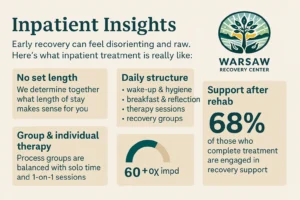
There’s no magic number. Some people stay for 30 days. Others stay for 60, 90, or longer. At Warsaw Recovery Center, we work with you to determine what makes sense based on your emotional state, history of use, mental health needs, and life circumstances.
Here’s what we tell people: healing takes what it takes. And sometimes, that means staying longer than you planned. Not because you’re failing—but because your nervous system deserves enough time to stop running.
Think of treatment like planting a tree. The roots don’t take hold on day one. They settle in slowly. Quietly. And if you yank them out too soon, the tree can’t grow. Your time in inpatient care gives your recovery the anchoring it needs—so when you walk out the doors, you’re not just “clean,” you’re equipped.
What Will My Daily Schedule Be Like?
If you’ve been living in survival mode, structure can feel foreign at first. But it’s not here to restrict you. It’s here to help you feel safe.
Your days will follow a rhythm—not a rigid schedule, but a supportive one. At Warsaw, a typical weekday might look like this:
- 7:00–8:00am: Wake-up and morning hygiene
- 8:00–9:00am: Breakfast and morning reflection group
- 9:30–11:30am: Group therapy or psychoeducation sessions
- 12:00–1:00pm: Lunch and rest
- 1:30–3:30pm: Individual therapy or experiential therapy (art, movement, trauma-informed modalities)
- 4:00–5:00pm: Peer-led groups or recovery journaling
- 5:30–6:30pm: Dinner
- 7:00–8:00pm: Evening wrap-up or soft group (gratitude, storytelling, etc.)
- 9:00pm: Personal time and wind-down
Weekends often include less formal programming—more time for reflection, movement, outdoor walks, spiritual services (if you choose), or phone calls with loved ones.
This rhythm offers something many clients haven’t had in years: predictability. It lets your body exhale. It tells your brain, You’re not in danger anymore.
Will I Be in Group Therapy All Day?
No. While group therapy is part of the experience, it’s balanced with solo time, individual therapy, expressive modalities, and space to just be.
At Warsaw Recovery Center, we understand that healing happens in different ways for different people. For some, talking in a group opens the floodgates. For others, it’s drawing, walking, or finally getting a full night of sleep.
Group sessions are facilitated by licensed clinicians and often include:
- Process work (sharing experiences and emotions)
- Skills groups (learning tools for anxiety, anger, relationships)
- Relapse prevention and boundary setting
- Inner child work or identity-based healing
But if you’re not ready to speak, that’s okay. You’re never forced to share. Being present is enough. Listening is participating.
What If I Don’t Know How to Be Alone With Myself?
Many people in early recovery say the same thing.
When you stop using substances, you lose your primary coping tool—and sometimes your main way of filling time. Suddenly you’re alone with your thoughts, and those thoughts aren’t always kind.
We plan for that. We talk about it. We support you through it.
In between programming, you’ll have personal time—time to rest, journal, listen to music, or take walks. You’ll also have access to staff and peers, so even in your alone time, you’re not actually alone.
What we’ve seen over and over: solitude becomes safer when you’re surrounded by community. The loneliness starts to feel less sharp. The silence turns into rest.
Can I Talk to My Family or Loved Ones?
Yes, with intention and care.
Not all relationships are safe in early recovery. Some are painful. Some are fragile. Some are deeply important.
We work with you to identify which connections will support your healing—and how to navigate the rest.
This might include:
- Weekly phone calls
- Family therapy sessions
- Letters or scheduled visits
- Help setting healthy communication boundaries
Our clinicians also support your loved ones. Many families feel lost too—and they need their own kind of recovery education. We offer guidance so they can support you without enabling or overwhelming you.
Connection doesn’t have to be cut off. It just has to be restructured to protect your progress.
What If I Don’t Feel Like I Belong?
That’s okay. Most people feel like outsiders on day one.
It takes courage to enter treatment. And for people who’ve been numbing, hiding, or fighting their way through life—it’s common to wonder, What if I don’t fit here? What if I’m too broken?
You’re not.
In group, you’ll hear someone say something you’ve never said out loud—but have thought a hundred times. You’ll meet people who don’t flinch when you tell the truth. You’ll start to see that your pain isn’t proof you’re beyond help. It’s proof that you’re still alive—and that means there’s still something worth fighting for.
Belonging doesn’t happen in a flash. It grows. Quietly. One honest moment at a time.
What Happens When I Leave?
We don’t send you back out into the world with a goodbye and a printout.
From the beginning of your stay, we’re already planning for the next step. Whether that’s transitioning to an intensive outpatient program in Virginia, sober living, or community support, we build a plan together—one that reflects your values and your needs.
Your discharge plan may include:
- A follow-up therapist or psychiatrist
- A recovery community (12-step, SMART Recovery, or others)
- Support for job search, school, or family reconnection
- A safety plan for moments of doubt or urge
- Ongoing alumni support from Warsaw Recovery Center
You won’t leave without knowing where to go next.
What If I Don’t Feel Ready Yet?
Then you’re exactly where you’re supposed to be.
Readiness isn’t a feeling. It’s a decision. A choice to stay—even when it’s hard. A willingness to sit still. A tiny voice that says, I don’t know what’s next—but I’m willing to find out.
You don’t need to feel strong. You just need to stay open.
Inpatient treatment is a space where the pressure to be “okay” finally lifts. You don’t have to perform here. You just have to show up.
That’s enough.
If you’re tired of holding everything by yourself—we’re here.
Call (888) 511-9480 to learn more about our Inpatient Treatment Programs in Warsaw, Virginia. You don’t have to have all the answers. Just one step is enough. We’ll meet you there.