

I used to say treatment didn’t work.
And I meant it—kind of.
I’d gone, twice. Once inpatient. Once outpatient. I sat through the groups, nodded in therapy, played nice with the techs. And then I’d go home and drink. Or sneak drinks in the car before sessions. Or promise myself I’d stop on Monday, then pour whiskey into my coffee by Tuesday.
I wasn’t rebellious. I was exhausted. And if you’re reading this—wondering if you’re just one of those people treatment doesn’t “stick” to—I want to tell you something that took me years to believe:
It’s not that treatment didn’t work.
It’s that I didn’t know what kind of treatment I actually needed.
And I didn’t know how to stop performing recovery instead of participating in it.
Everything started to change when Medicaid opened a door I thought was closed for good. And everything actually changed when I stopped pretending.
I Looked “Fine” on the Outside
I wasn’t the “rock bottom” type—at least not visibly. I held down a job, sort of. I kept up appearances with my family, sort of. I showed up to sessions, smiled politely, didn’t make waves.
And no one really knew that I drank before therapy.
Or that I drank after it.
Or that I hated myself more every time I did.
Because I knew better. I’d been to treatment. I had the lingo. I could list coping skills like flashcards. None of it was sinking in—because I never let myself get honest.
I told people I was trying. But really, I was performing.
I Told Myself “It’s Too Expensive to Try Again”
It was a good excuse. Real, too. I didn’t have the cash for another round of treatment, and the thought of asking for help again made me feel sick. What would I even say? “Hey, remember when I said I was better? Yeah… about that.”
But someone at a local health center asked if I had Medicaid.
I did. I just didn’t think it covered anything useful.
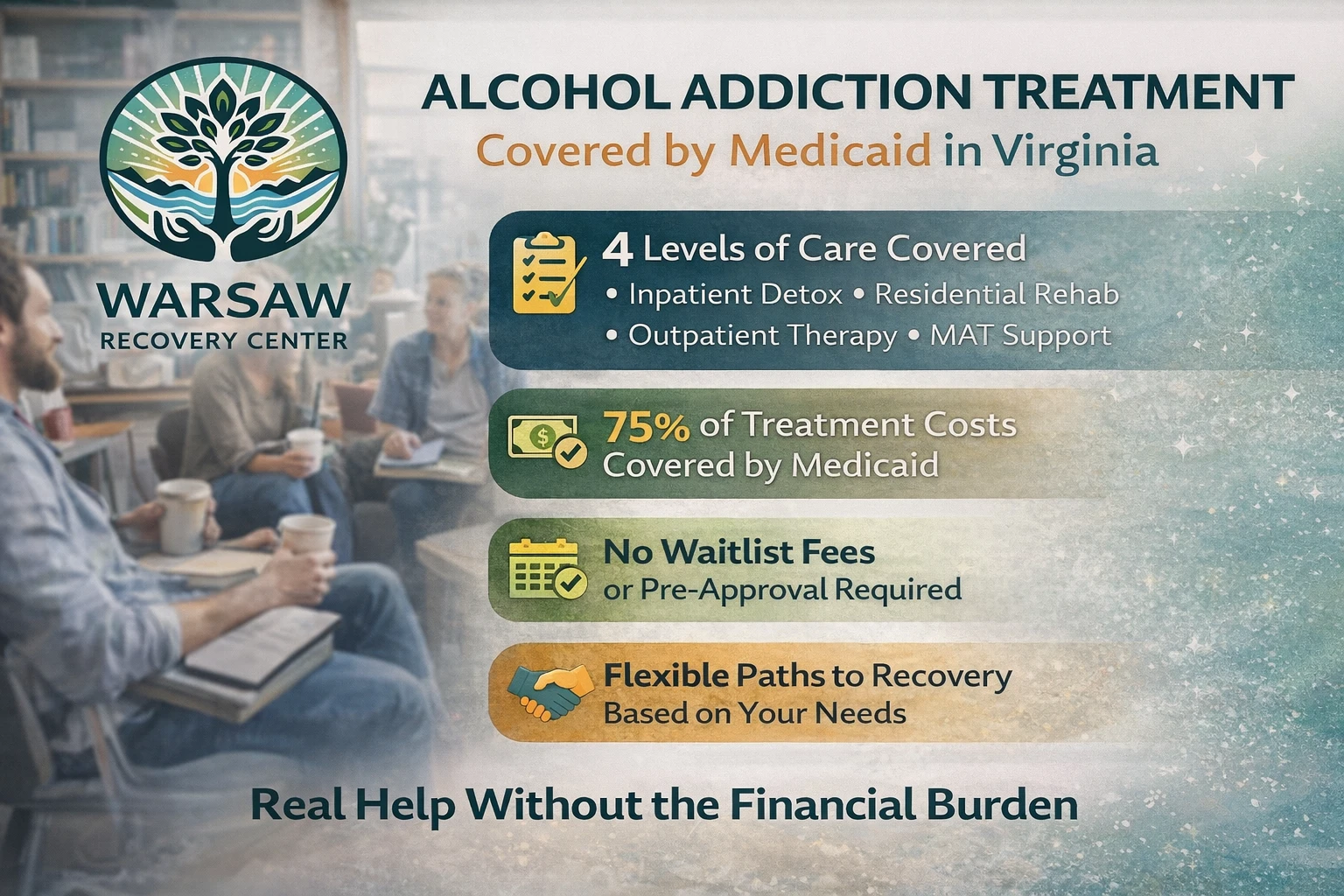
Turns out, Medicaid in Virginia does cover alcohol addiction treatment. And not just basics—real services: inpatient detox, residential programs, outpatient support, therapy, even MAT if you need it.
Suddenly, the “I can’t afford it” excuse didn’t hold up.
I ran out of reasons not to try again.
So I walked into Warsaw Recovery Center’s alcohol addiction treatment program scared, hungover, and sure I was wasting everyone’s time.
But I walked in.
I Didn’t Need a Breakthrough. I Needed a Break From Pretending.
Here’s the first thing I noticed: no one tried to sell me hope.
No inspirational speeches. No “we believe in you!” hype.
Just:
“Thanks for coming in.”
“Here’s what your Medicaid covers.”
“Let’s talk about what’s been happening.”
It was weirdly comforting. Like, maybe I didn’t need to put on the recovery costume this time. Maybe I could say the thing I’d been holding back in every intake interview before this:
“I don’t know if I can do this. I don’t even know if I want to do this. But I know I can’t keep doing that.”
And instead of flinching or lecturing, my counselor said:
“Okay. Let’s start from there.”
Group Was the First Place I Didn’t Fake It
Group therapy used to be where I told stories with the edges filed off. Stuff that made me sound like I used to struggle, but was clearly on the “getting better” side of things now.
It was all for show.
This time, I said what was actually true:
- That I still thought about drinking every time I passed the gas station.
- That I didn’t believe my family would ever trust me again.
- That I hated calling myself an alcoholic because it made me feel small.
And someone across the room nodded. Then someone else added, “Same.”
And for the first time, I realized: maybe I wasn’t here to impress anyone. Maybe I was here to heal.
I Still Slipped—And I Wasn’t Punished
About a month in, I drank again.
I didn’t plan to. I just felt lonely, tired, and that old reflex kicked in: drink it away.
The next day, I showed up to group. Hungover. Ashamed. Expecting to be kicked out or scolded.
Instead, my counselor said, “Thanks for showing up. Let’s look at what led up to it.”
That moment did more for my recovery than any milestone.
Because it taught me that treatment isn’t about performing perfect behavior.
It’s about staying connected, even when you screw up.
Medicaid Didn’t Just Cover Treatment. It Gave Me Access to a New Story.
Without Medicaid, I would’ve stayed stuck in the shame spiral—thinking I couldn’t afford care, didn’t deserve another chance, and couldn’t trust myself to change.
But because of that coverage, I could show up messy. I could show up unsure. I could show up real.
And real recovery is built on realness, not performance.
At Warsaw, I got access to:
- Therapists who didn’t expect me to be hopeful—just honest
- Group sessions where no one was posturing
- Flexible outpatient options that fit my work schedule
- Medication support to manage cravings when I felt too close to relapse
And most of all, I got space. Space to stop pretending. Space to let the healing happen slowly.
If You Think Treatment Didn’t Work—Ask Why
Not as a guilt trip. But as a curiosity.
Was it the wrong format? The wrong timing? The pressure to say what you thought people wanted to hear?
You might not be burned out on treatment itself. You might be burned out on faking your way through it.
There’s another way to do this. And if Medicaid can take the money excuse off the table, you might finally be able to try the real thing—with your full self this time, not just the version you think they’ll accept.
Call (888) 511-9480 to learn more about our alcohol addiction treatment services in Virginia.
FAQs: Medicaid & Alcohol Addiction Treatment
Does Medicaid really cover alcohol addiction treatment?
Yes. In Virginia, Medicaid covers many forms of treatment—including inpatient detox, residential rehab, outpatient therapy, MAT (like naltrexone or disulfiram), and mental health support.
What if I already used treatment and it “didn’t work”?
You’re not alone. Many people need to try more than once—or find a format that fits better. That doesn’t mean you failed. It means you’re still trying. And trying is recovery, too.
Can I get help if I relapse during treatment?
Yes. Most quality programs (like Warsaw’s) expect setbacks and offer support without judgment. Relapse doesn’t end your care—it’s a moment to adjust it.
Is there a waitlist to use Medicaid for treatment?
Some programs have waitlists, but Warsaw can often help you navigate that and connect you with available services quickly. Calling is the best first step.
Do I have to commit to inpatient care?
Not necessarily. Medicaid covers a range of services. You can explore outpatient options, intensive day programs, or therapy support depending on your needs.