
You were starting to breathe again.
They went to treatment. They said they were done drinking. Maybe they moved back home for a while. Maybe they even made it a few months—or longer—without relapsing.
You didn’t expect perfection. But you were beginning to hope. You started sleeping through the night again. You started saying “my kid is doing better” out loud.
And now? Something’s off.
They’re defensive again. Sleeping all day. Snapping over nothing. Going silent. You know the signs because you’ve seen them before. And maybe the hardest part is this: you already know what’s happening.
If you’re wondering whether it’s time to explore alcohol addiction treatment in Warsaw, Virginia again, you’re not alone. And you’re not failing.
This may be the hardest version of love there is—the love that keeps showing up when it would be easier to shut down.
Why Relapse Doesn’t Mean “Back to Zero”
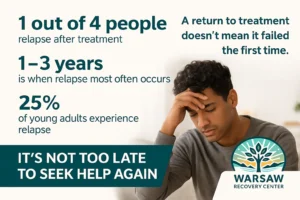
We need to say this clearly: a return to treatment doesn’t mean the first round failed.
Relapse is common. Especially for young adults. Especially in the first 1–3 years after initial treatment.
Here’s why:
- Brain development is still underway well into the mid-20s.
- Identity is still forming. Many are still figuring out who they are without substances.
- Life gets louder after treatment—school, friends, work, relationships. Triggers show up.
- And the truth? Some go to treatment the first time because someone else wanted them to. The second time is often the first time they want it for themselves.
Think of early recovery as learning to swim. They may have had a lifejacket the first time. Now they’re trying to tread water. And when they start to slip, they don’t need lectures. They need a hand back to the surface.
The Signs Might Be Subtle—But They’re Not Imagined
Relapse doesn’t always show up as chaos. Sometimes it creeps in.
Here’s what parents often notice first:
- They’re suddenly hard to reach again—slow to respond to texts or calls.
- Their sleep and eating patterns change.
- They’re back to hanging out with old using friends.
- Their mood shifts—more irritability, defensiveness, or detachment.
- They lie about small things again, even when there’s no need.
- You notice alcohol missing. Or you find evidence and feel like you’re losing your mind.
If your body is reacting before your brain can catch up—tight chest, shallow breathing, that awful feeling in your gut—it’s worth paying attention. Your instincts are not drama. They’re data.
What You Can Say (And What Often Works Better)
We know this isn’t your first rodeo. But that doesn’t make it easier.
What’s hard now is that you’ve already had the talk. Maybe multiple times. You’ve already Googled the programs. Already said, “I love you, but I won’t watch this happen again.”
So how do you say it—again?
Try this:
“I know you’ve worked hard. And I know something’s off right now. I’m not here to blame. I’m here to help—if and when you want it.”
That sentence does a few things:
- It acknowledges their effort.
- It names the current reality without shame.
- It leaves a door open without pushing them through it.
What to avoid:
- “You promised.”
- “You’re doing this again?”
- “We’re not paying for treatment again.”
Even if you feel those things (which is valid), they rarely lead to change. Most people don’t come back to treatment because of pressure—they come back because someone believed they were still worth saving.
Why It Might Be Harder for Them to Say Yes the Second Time
Relapse doesn’t just bring back old behavior. It brings new shame.
They may feel like they let you down. Let themselves down. Let their counselor or sober friends down.
They may be afraid of judgment. Afraid that this time, no one will believe in them.
That fear can sound like defiance. But underneath it? It’s usually grief.
They might also be unsure of what another round of alcohol addiction treatment would even look like. Will it just be the same groups? The same lectures? Will anyone really hear them differently?
That’s why at Warsaw Recovery Center, we don’t just copy/paste a plan. We build a new one—with them, not just for them.
How Treatment Can Look Different the Second (or Third) Time
If you’re considering treatment again, you might wonder: what’s the difference this time?
Here’s how we approach repeat care:
- We reassess the whole picture. What’s changed since last time? What worked, what didn’t?
- We adapt the level of care. Maybe they don’t need residential again. Maybe intensive outpatient is a better fit now.
- We dive deeper. Maybe trauma or mental health challenges are surfacing more now. Maybe they’re ready for therapy in a way they weren’t before.
- We slow down shame. Our staff knows what relapse does to a person’s sense of worth. We help them remember it doesn’t define them.
This isn’t about repeating what didn’t work. It’s about building something that does—now, at this stage of life.
You’re Not Starting Over—You’re Continuing the Work
It might feel like a step back.
But here’s the truth: if they choose treatment again, that’s a step forward in self-awareness.
Every return to care is a chance to strengthen what’s already there.
Think of recovery like scaffolding. The first time might have built the base. The second time adds structure. The third? That’s often where stability finally settles in.
And for you, as a parent, this isn’t failure either.
You’ve been showing up—tired, maybe, but still standing. That matters. You don’t have to carry the next phase alone.
FAQs: When It Might Be Time for Treatment Again
How do I know it’s relapse and not just stress?
It can be hard to tell—but if old patterns are re-emerging and trust is eroding again, it’s worth exploring. Even if it’s not full-blown relapse, early intervention is often more effective than waiting for a crisis.
What if they refuse to go back to treatment?
You can’t force healing—but you can create conditions that make it harder to keep using comfortably. That might mean setting boundaries around money, housing, or communication. You can also offer to go with them to talk to a professional about options.
Will the second round of treatment actually help?
Yes. In fact, many people engage more meaningfully after relapse. They’re often more open, more honest, and more motivated. Treatment works best when someone is ready to be in it—and relapse can be a painful but clarifying experience.
How do I deal with my own feelings about this?
First, acknowledge them. Rage, sadness, disappointment, numbness—all normal. Second, consider support for yourself. Al-Anon, therapy, or parent-focused groups can give you space to grieve and breathe. You deserve care, too.
Can Warsaw Recovery work with someone who’s been to other programs?
Absolutely. We welcome clients returning from prior programs. We offer fresh assessments, individualized plans, and staff experienced in working with returning clients.
It’s Not Too Late. And You’re Not Alone.
Call (888) 511-9480 or visit our alcohol addiction treatment services in Warsaw, Virginia to speak with someone who understands relapse, supports recovery at every stage, and honors your role as a parent trying to help—again, with hope and clarity.