Some people hit rock bottom. Others land on it, bounce, and land again. If you’re reading this, you might be somewhere in between. You’ve tried treatment before. Once? Twice? More than that? You walked in with hope and left with… disappointment. Maybe you relapsed. Maybe you ghosted. Maybe you stayed sober for a while but felt hollow the whole time.
And now you’re here again. Tired. Hesitant. Wondering if it’s worth trying one more time.
At Warsaw Recovery Center’s Inpatient Treatment Program in Virginia, we meet people in that exact space every day. People who aren’t looking for another polished promise. They’re looking for something real. And we believe that inpatient treatment doesn’t just help you stay sober—it helps you start over, without pretending nothing happened before.
When You’ve Tried Before (And It Didn’t Help)
There’s a unique kind of pain that comes with trying to heal and feeling like it didn’t work.
You told your family you’d get help. You packed the bag. You did the groups. Maybe you even felt better for a while. But then something cracked. You slipped. Or you didn’t connect. Or life outside the program felt too heavy to hold alone.
And now the idea of trying again feels… exhausting. Or maybe even embarrassing.
We get it. You’re not alone in that. Many of our clients come to Warsaw feeling skeptical or discouraged. But here’s the truth: relapse doesn’t erase your progress. Treatment that didn’t stick doesn’t mean treatment failed—it might just mean it wasn’t the right place, the right time, or the right approach.
Inpatient Treatment Programs Are Built for Complex Stories
This isn’t your first time. We know that. So we’re not going to treat you like a blank slate.
Inpatient treatment isn’t a punishment or a reset. It’s a pause. A place to regroup. To look honestly at what’s been working, what hasn’t, and what you need now.
Our inpatient programs are immersive. You live on-site, which gives you a buffer from everyday triggers, decisions, and emotional chaos. It creates a space where you can finally stop surviving long enough to breathe—and begin to rebuild.
And when you’re in that space, healing isn’t theoretical. It’s practiced. In conversations. In structure. In silence. In peer connection. In moments where you feel like giving up and someone quietly sits next to you instead of offering advice.
What If I Don’t Trust Treatment Anymore?
You don’t have to. Not completely. Not yet.
At Warsaw, we don’t need you to walk in believing this will be the thing that “finally works.” We just need you to be open to something being different. A little different. A little better.
Distrust isn’t a barrier—it’s a signal. It means you’ve been through something real. We honor that.
You’re not “resistant.” You’re human. And we meet that resistance with consistency, not pressure. We don’t push people into big emotional breakthroughs on Day One. We don’t hand out cookie-cutter worksheets and call it progress. We move with you, not ahead of you.
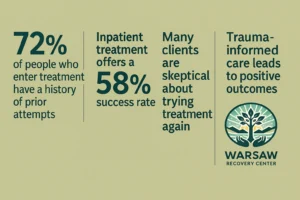
What Makes Warsaw’s Inpatient Treatment Different?
We know the difference between checking boxes and changing lives.
Some programs focus on structure—but forget to focus on people. Others promise transformation in 30 days, but ignore the realities of trauma, grief, or relapse.
Warsaw Recovery Center isn’t about shortcuts. We’re about sustainable change. That means:
- Trauma-aware therapy that doesn’t retraumatize
- Groups that go beyond scripts and dig into real conversation
- Staff who’ve walked their own roads, and know how to walk beside you
- Care plans that evolve as you do—no stagnant goals, no forced timelines
You’re not a diagnosis here. You’re a person who’s been through things—and you deserve care that reflects that complexity.
When Hope Feels Like a Setup
Let’s be honest: “hope” can feel like a scam when you’ve been let down before. Sometimes it feels safer not to expect anything—because then at least you can’t be disappointed.
We hear that all the time. We don’t take it personally.
Hope doesn’t have to be fireworks. Sometimes it’s just deciding to stay through the weekend. Sometimes it’s making one honest comment in group, or unpacking your bag instead of leaving it by the door.
These small choices matter. Because they build the muscle of showing up. And that’s the muscle that carries recovery forward.
You’re Not Starting Over—You’re Starting With More
This isn’t square one. Not really. You’re not who you were before.
You’ve learned things—hard things. You’ve seen what happens when you run, when you numb, when you push people away. That knowledge isn’t failure. It’s fuel.
And you get to bring all of that here. To inpatient treatment that respects your experience and doesn’t pretend you’re new to this. You’re not starting over. You’re starting again—but this time, with eyes open.
FAQs About Inpatient Treatment After Setbacks
Is it normal to need inpatient treatment more than once?
Yes. Many people go through treatment multiple times before it sticks. Recovery isn’t linear. Each attempt builds on the last—even if it doesn’t feel like it right away.
What if I left another program early?
You’re still welcome. Whether you walked out, relapsed, or just didn’t connect, we don’t hold your past against you. We want to understand it—and help you move forward from it.
Do I have to commit to long-term treatment?
No. We’ll work with you to build a care plan that fits your needs and goals. Some people start short and extend. Some start with long-term goals. Either way, we adjust together.
Can I keep my job or stay connected with family while in treatment?
Many of our clients arrange leave from work under FMLA or similar protections. We can help you explore those options. Family involvement is also part of our program, especially for those wanting to rebuild relationships.
What if I still don’t think I can do this?
That’s okay. You don’t have to believe in the whole process right now. You just have to take one small step. Call. Ask a question. Let us meet you where you are.
This Time, It’s Not About Being Perfect—It’s About Being Honest
Recovery that sticks doesn’t come from perfection. It comes from honesty. From finally saying, “I don’t know if this will work, but I’m tired of doing it alone.”
And if that’s where you are? That’s enough. You don’t need to fake hope. You don’t need to be sure. You just need to come in as you are—and let that be the starting point.
We’ll meet you there. No judgment. No pressure. Just real, structured support in a place that sees you as a person—not a problem.
Tired of trying alone? Let us help carry what’s too heavy right now.
Call (888) 511-9480 to learn more about our Inpatient Treatment Programs services in Warsaw, Virginia. You don’t have to believe in full recovery yet—just believe you’re worth one more shot.