There wasn’t one big moment. It was the slow bleed of little ones.
The promises that dissolved before dinner. The excuses that turned into full-blown lies. The version of the person I loved—slipping further and further behind their eyes.
For a long time, I told myself things would get better if I just loved them right. If I gave more grace, more space, more chances. But the truth? I was giving pieces of myself to someone who couldn’t hold them. And eventually, I had to choose between preserving the relationship and preserving my sanity.
That’s when I started looking into a residential treatment program in Warsaw, Virginia. I didn’t do it lightly. But I did it out of love—the kind that doesn’t just hope, but acts.
I Didn’t Want to Push—I Wanted Them to Choose
I remember whispering this to a friend when I first started researching options: “I don’t want to force anything. I want them to be ready.”
But I also remember what it felt like to watch them spiral while I waited for “ready” to arrive.
They weren’t getting better on their own. The damage wasn’t slowing down. And the idea that they had to hit rock bottom before they could get help felt more like a death sentence than a plan.
What I learned is this: readiness doesn’t always come before action. Sometimes, the decision to go to treatment comes because someone we love finally names the truth out loud.
Residential Treatment Wasn’t the First Option—It Was the Last One Left
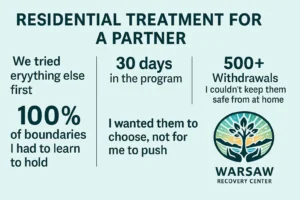
We tried everything else first.
- “Let’s cut back together.”
- “Maybe you just need therapy.”
- “What if we take a break from drinking during the week?”
- “Okay, just weed—nothing else.”
- “What about outpatient?”
Each conversation felt like a negotiation with a ghost—someone I used to know, someone I still loved, someone I hoped was still in there.
But nothing stuck.
They’d get defensive. Or agree, but then fall back. Or lie.
And I’d forgive. Again. And again.
Until finally, I hit my own bottom: the realization that love without boundaries isn’t love—it’s permission.
What Changed When I Found Warsaw Recovery Center’s Residential Treatment Program
It wasn’t some magical fix, and it definitely wasn’t easy. But it was real. And that was more than we’d had in a long time.
I didn’t know what to expect when I called. I thought maybe I’d be talked over, or judged, or told I was overreacting.
Instead, I spoke to someone who got it.
They didn’t rush me. They didn’t pressure me. They just explained what residential treatment could offer—things I hadn’t thought about:
- Stability: A structured space where my partner could be safe from triggers and temptation
- Medical support: Supervision during withdrawal that I couldn’t manage at home
- Real therapy: Not just once a week, but every day—focused, specific, and ongoing
- Time: To reflect, to feel, to start again—not in crisis mode, but in real life
It didn’t feel like an institution. It felt like a pause button. A boundary wrapped in compassion. And for both of us, that made all the difference.
What I Actually Said (When I Finally Spoke the Truth)
This was the hardest part. Not the research. Not the logistics. But the conversation.
I waited until they were sober (ish). Calm. And then I said:
“I love you. I know you’re in pain. I know you’re trying. But what we’re doing isn’t working. I can’t keep watching this happen. I found a place that can help. And I’m asking you to go—not because I’m done with you, but because I still want us.”
They didn’t say yes that day.
But they didn’t leave. And that was the first time I realized the door might not be as closed as I feared.
How the Program Helped Them Heal—And Me Too
They were in for 30 days. I thought I’d be counting down the hours. But honestly? I needed the space as much as they did.
While they were doing groups, I started going to therapy. While they wrote letters, I stopped checking their location history every hour. While they were learning how to feel things again, I started to notice how numb I’d become.
The program gave them tools. But it gave me permission—to exhale, to rest, to stop being the emergency contact and start being me again.
When they came home, things weren’t perfect. But they were different. We had words for things. Boundaries. Plans. And for the first time in a long time—hope that didn’t feel like a lie.
What I Want You to Know If You’re in This Place Right Now
You’re not crazy. You’re not selfish. You’re not controlling.
You’re a person who’s been loving someone in survival mode for way too long.
And you’re allowed to ask for change—even if it’s uncomfortable. Especially if it’s uncomfortable.
If you’re thinking about a residential treatment program for your partner, you’re not betraying them. You’re trying to save something worth saving.
Start with a conversation. Start with research. Start with this page. You don’t have to know everything. You just have to start somewhere.
FAQs About Residential Treatment for a Partner or Spouse
What if my partner won’t go?
You can’t force someone to go to treatment. But you can create boundaries that protect your wellbeing. That might sound like: “I love you, but I can’t stay in this dynamic unless you’re willing to get help.” It’s not a threat. It’s a line.
What if they go just to keep me happy?
That’s okay. Motivation can shift over time. Many people enter treatment resistant or unsure—and find their own reasons to stay. The important thing is getting them in a space where recovery is possible.
Will I be involved in their treatment?
Yes, at Warsaw Recovery Center, family involvement is part of the process. You may be invited to participate in family sessions, receive updates, or access resources for your own support.
How long is residential treatment?
It varies. Most programs are 28–30 days, but some last longer based on clinical needs. The team will create a plan that fits your partner’s situation.
What if they relapse after?
It happens. Relapse doesn’t erase progress—it just signals that more support is needed. Many couples use that as a moment to deepen boundaries, refine plans, and keep moving forward.
Loving Someone Shouldn’t Mean Losing Yourself
For too long, I thought love meant endurance.
But real love—the kind that heals—sometimes requires brave decisions. Residential treatment gave my partner the tools they needed. But it also gave me something I didn’t realize I’d lost:
Clarity. Peace. A future I could imagine again.
If you’re standing at your own breaking point, please know you’re not alone.
Call (888) 511-9480 or visit our Residential Treatment Program page to learn more. Whether they say yes today, next week, or not at all—you’re allowed to choose healing. For them. For you. For both.