

You didn’t mean to disappear.
Maybe you missed one session. Then another. Life got loud. The car broke down. Work got hectic. Your kid needed you. Or maybe you just felt… off. Not ready. Not “in it” anymore.
Whatever the reason, treatment drifted into the background. And now you’re staring at your phone, unsure how to even begin coming back.
If life is pulling you away from alcohol addiction treatment in Warsaw, Virginia, you’re not broken. And you’re not alone.
Here’s how to get honest about what’s happening—and what to do next.
1. Missing a Few Sessions Doesn’t Mean You Blew It
First, let’s kill the shame script.
You’re not the first person to pause treatment. You’re not the first person to ghost a group, silence your reminders, or fall off the radar.
And you know what? It doesn’t mean you failed. It means you’re human.
Shame tells you that because you disappeared, you don’t deserve to come back.
But healing says this instead:
The fact that you’re reading this means you’re still trying.
That’s not failure. That’s awareness.
2. Life Will Always Compete With Recovery—You’re Not Wrong for Feeling Pulled
It’s okay to admit that life pulled at you.
People think recovery exists in a vacuum. That you “just focus on yourself” and everything else pauses.
It doesn’t.
Bills still come. Work still calls. Kids still need rides. Relationships still hit bumps. Bodies still get sick. And your mental health? That doesn’t magically stabilize just because you started showing up to group.
If anything, recovery tends to uncover what you were numbing—and that can feel overwhelming.
So when life gets heavy, it’s not weakness to shift your energy. It’s survival.
The trick isn’t pretending life won’t pull you. It’s learning how to hold onto recovery while it does.
3. Map Out What Pulled You Off Course
Before you decide what to do next, look at what got in the way.
Ask yourself:
- Was I overwhelmed by the schedule?
- Did group feel emotionally unsafe or too intense?
- Did I start feeling better and think I didn’t need it anymore?
- Did something trigger me that I didn’t know how to talk about?
- Was it shame? Fatigue? Logistics?
Naming the real friction point is how you stop the shame spiral—and start finding your re-entry point.
You’re not lazy. You’re not broken. You just hit a roadblock.
And we can help you move through it. But first, let’s be real about what it was.
4. Texting “I Want to Come Back” Is Enough
You don’t need to rehearse a long explanation. You don’t need to apologize for ghosting. You don’t need to prove you’re committed again.
Try this:
“Hey, I’ve been off track. I want to talk about coming back.”
Or:
“Can we set up a check-in? I’ve been struggling.”
That’s it.
At Warsaw Recovery Center, we don’t ask you to perform recovery. We just want you to re-enter. And that starts with one honest message.
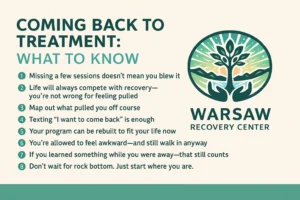
5. Your Program Can Be Rebuilt to Fit Your Life Now
Maybe the schedule stopped working for you. Maybe the level of care was too much or not enough.
Let’s revisit it.
We offer multiple alcohol addiction treatment paths in Warsaw, Virginia:
- Intensive Outpatient Programs (IOP) for structure and support without full-time disruption
- Flexible outpatient care that adapts to your job, parenting, or school
- Telehealth or hybrid options for when commuting becomes a barrier
- Step-up or step-down transitions if your needs change
This isn’t a punishment loop. It’s a plan that gets smarter every time you come back with more information.
6. You’re Allowed to Feel Awkward—And Still Walk In Anyway
One of the hardest parts of returning to treatment?
The story in your head: They’re going to judge me. They’ll think I wasn’t serious. I’m too far behind now.
That fear is real. But it rarely plays out the way you expect.
What usually happens is someone in group says,
“Glad you’re back.”
And then the group keeps going.
And you remember why you came in the first place.
We see returning clients all the time. Not with shame—but with quiet strength. The kind of strength it takes to walk back into a space that once held you when you were struggling.
And honestly? That kind of comeback deserves more respect than perfection ever will.
7. If You Learned Something While You Were Away—That Still Counts
Sometimes people drift from treatment but stay dry. Or they relapse, but learn something valuable in the process.
Either way—what happened while you were away still matters.
Maybe you realized what your true triggers are. Maybe you finally felt the cost of isolation. Maybe you learned that you can come back to yourself after a slip.
Those are not just stories of “what went wrong.” They’re insights into what you need now.
And that’s what recovery is—a conversation with yourself that deepens over time.
8. Don’t Wait for Rock Bottom. Just Start Where You Are.
You don’t have to be falling apart to re-enter treatment. You don’t have to relapse. You don’t have to crash your car or lose your job or have someone threaten to leave you.
You can come back when you’re just tired. Or numb. Or when you realize you’ve been coasting through your days again.
That’s what growth looks like. Not waiting for pain to force your hand—but responding to discomfort when it starts whispering.
And if it’s whispering now?
We’re ready.
FAQs: Re-Engaging With Alcohol Addiction Treatment After a Pause
I ghosted mid-program. Will I have to start over?
Not necessarily. We’ll meet with you to review where you left off, what worked, and what needs to be adjusted. Often, you can pick up with modifications—not a total restart.
What if I relapsed while I was gone?
You’re still welcome. Relapse happens. What matters is that you’re coming back. We’ll provide support, not shame—and adjust your plan to meet you where you are now.
I’m embarrassed to see the same group again. Can I switch?
Yes. If a fresh group or clinician would help you feel safer or more engaged, we’ll work with you on that. Your emotional safety matters.
I dropped out because life got in the way. Will you still take me back?
Absolutely. Life gets messy. Treatment is designed to support your real-world recovery—not punish you for being overwhelmed.
Do I have to explain why I left?
Only if you want to. We’ll invite you to share what you’re comfortable with—but your return alone speaks volumes. No long justification required.
You Haven’t Failed. You Just Hit Pause.
Call (888) 511-9480 or visit our alcohol addiction treatment services in Warsaw, Virginia to restart your recovery with the same honesty you brought the first time. We’re not keeping score. We’re just keeping the door open.