There comes a moment when the question changes.
Not “Are they using again?”
But: “Are they safe?”
If you’re here, your heart may already know the answer.
You’ve been watching someone you love disappear—under the weight of their substance use, their silence, or their suffering. Maybe you’ve tried to help. Maybe you’re scared to try again. But something tells you: this might be more than you can manage alone.
That’s where medical detox comes in. It’s not a punishment. It’s a beginning.
Detox can be lifesaving when substance use becomes medically dangerous—when the body has become so dependent that quitting cold turkey could trigger seizures, cardiac issues, or even death. But it’s also a place of hope: a structured, compassionate space to press pause and get help safely.
Here are 7 signs it might be time.
1. They’re showing physical signs of withdrawal
You know your child. You’ve seen them sick before. But this is different.
If they get shaky, nauseated, anxious, or sweaty when they’re not using—and seem better once they use again—it’s a sign their body has developed dependence.
In more severe cases, withdrawal can cause seizures, hallucinations, or dangerous spikes in heart rate or blood pressure. Detoxing alone in this state isn’t just difficult. It’s risky.
2. You’ve tried everything else, and nothing seems to help
You’ve had the hard talks. Set boundaries. Maybe even brought them to counseling or outpatient programs. Maybe they’ve promised to stop—meant it, even—but nothing sticks. It’s not a failure of love or effort. It may just be time for a different level of care.
A medical detox program doesn’t fix everything, but it lays a foundation. It stabilizes the body, so the mind has a fighting chance to heal.
3. They’re using more—and hiding it less
Substance use tends to escalate quietly. What used to be once in a while is now every day. What used to be subtle is now impossible to miss. Maybe you’ve noticed more money missing, more erratic behavior, or found hidden bottles, pills, or paraphernalia.
When use becomes more frequent and harder to control, detox becomes more than a helpful tool—it becomes a medical necessity.
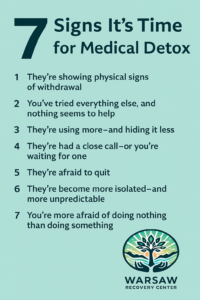
4. They’ve had a close call—or you’re waiting for one
You might already be on edge from a near-overdose, a trip to the ER, or a frightening phone call. Or maybe it hasn’t happened yet, but the possibility feels like a ticking clock.
A formal detox can be a way to act before the next emergency, not after. It offers medical monitoring, emotional care, and a moment of safety when things feel most unsafe.
5. They’re afraid to quit
“I can’t do this.”
“I want to stop, but I’m scared.”
“I feel like I’ll die without it.”
These aren’t dramatics. They’re real. Withdrawal can be terrifying, both physically and psychologically. A medical detox program helps take the weight off their shoulders by providing medication-assisted support, round-the-clock monitoring, and a calm, structured space to begin recovery.
6. They’ve become more isolated—and more unpredictable
When substance use escalates, isolation often follows. Maybe they’re sleeping all day, avoiding eye contact, or disappearing for hours—or days—at a time. The more disconnected they become, the harder it is to reach them, and the more vulnerable they are to harm.
Medical detox reintroduces structure. It reconnects them to care, to people, and—eventually—to themselves.
7. You’re more afraid of doing nothing than doing something
Maybe this isn’t the first time. Maybe it’s the third. Maybe you’re exhausted by hope, wary of professionals, or just worn out. But if fear is keeping you awake at night—and action feels like the only relief—you don’t need permission to act.
Detox can be the beginning of the beginning. Not because it solves everything, but because it changes the trajectory.
When You’re the One Holding It Together
Being the parent of someone who’s using again doesn’t come with instructions. It comes with grief. Rage. Guilt. Confusion. And a thousand choices you never imagined having to make.
So if you’re unsure, scared, or simply ready for someone else to help hold the weight—know this:
You’re not alone.
You’re not failing.
And you’re not out of options.
At Warsaw Recovery Center, we work with families every day who are navigating the impossible. Our medical detox program in Virginia is designed to meet your loved one where they are—while giving you space to breathe.
Frequently Asked Questions About Medical Detox
What is a medical detox program?
A medical detox program is a supervised, short-term stay (typically 3–7 days) where individuals safely withdraw from drugs or alcohol with medical oversight. It includes 24/7 care, medication support, and emotional stabilization.
Is detox the same as treatment?
Not quite. Detox is the first step of treatment. It prepares the body for further care—whether that’s residential treatment, intensive outpatient, or therapy. Think of it as the emergency room before surgery.
Can someone refuse medical detox?
Yes. In most cases, detox is voluntary unless court-ordered. However, many people who initially resist detox later express relief once they’re admitted. Compassionate conversations, not ultimatums, often make the biggest difference.
What substances require medical detox?
Substances that commonly require medical detox include:
- Alcohol
- Benzodiazepines (Xanax, Valium)
- Opiates and opioids (heroin, fentanyl, prescription painkillers)
- Methamphetamines (depending on severity)
If you’re unsure what your loved one is using, our team can help assess.
How do I start the process?
Call us. That’s it. Even if you’re not sure they’re ready—or you’re not sure you are—we can talk it through together. Call now: (888) 511-9480.
You Don’t Have to Do This Alone
If your child is struggling, and you’re carrying more fear than answers—please know: you are not alone. There are people here who understand this kind of heartbreak. Who will meet you with care, not judgment.
Warsaw Recovery Center’s medical detox program is here for families across Warsaw, Virginia, and the surrounding areas. Whether it’s your child’s first detox—or their third—you’re not walking this alone. Call us directly at (888) 511-9480