

There’s a difference between finishing treatment and feeling safe again.
If your child has already been through detox, or even a 30-day program, but you still feel like you’re living in crisis—this blog is for you. You may be wondering why things still feel so fragile, or why you can’t shake the sense that something is off, even if your child is technically “doing better.”
At Warsaw Recovery Center, we’ve met hundreds of families at this very moment—where fear and hope exist in the same breath, and where parents are still carrying the emotional load long after the program ended. If that sounds like you, here are some of the real signs we’ve seen when short-term support simply isn’t enough—and why longer-term care might be what finally holds.
They Came Home, But You Still Don’t See Them
On paper, everything looks fine. They made it through detox. They completed treatment. Maybe they’re even back at work or school.
But when you look in their eyes, something’s missing. They’re flat. Or jumpy. Or unusually quiet.
You know your child’s energy. And if it still feels hollow, that’s not nothing. Finishing treatment doesn’t mean they’re emotionally stable. It often means they’re now facing what substances helped them avoid—without a safety net.
Long-term support gives space for that deeper healing to begin. It lets them learn how to live, not just how to survive.
You’re Still the Emergency Contact for Everything
If the phone ringing still stops your heart, that’s a sign.
You might be managing meds, juggling appointments, trying to keep them safe through nights that still feel risky. You’ve become the unofficial crisis line, therapist, and emotional center—and that’s not sustainable.
We recently spoke with a parent in Fredericksburg, Virginia who told us she hadn’t slept through the night in six months—not because her daughter was using, but because she was constantly worried she would. The day-to-day pressure hadn’t let up, even after treatment.
This is often a clue that short-term programs gave them a pause—not a plan. That’s where long-term support comes in: to reduce the weight on families and create stability that doesn’t live or die by whether a parent is available at all times.
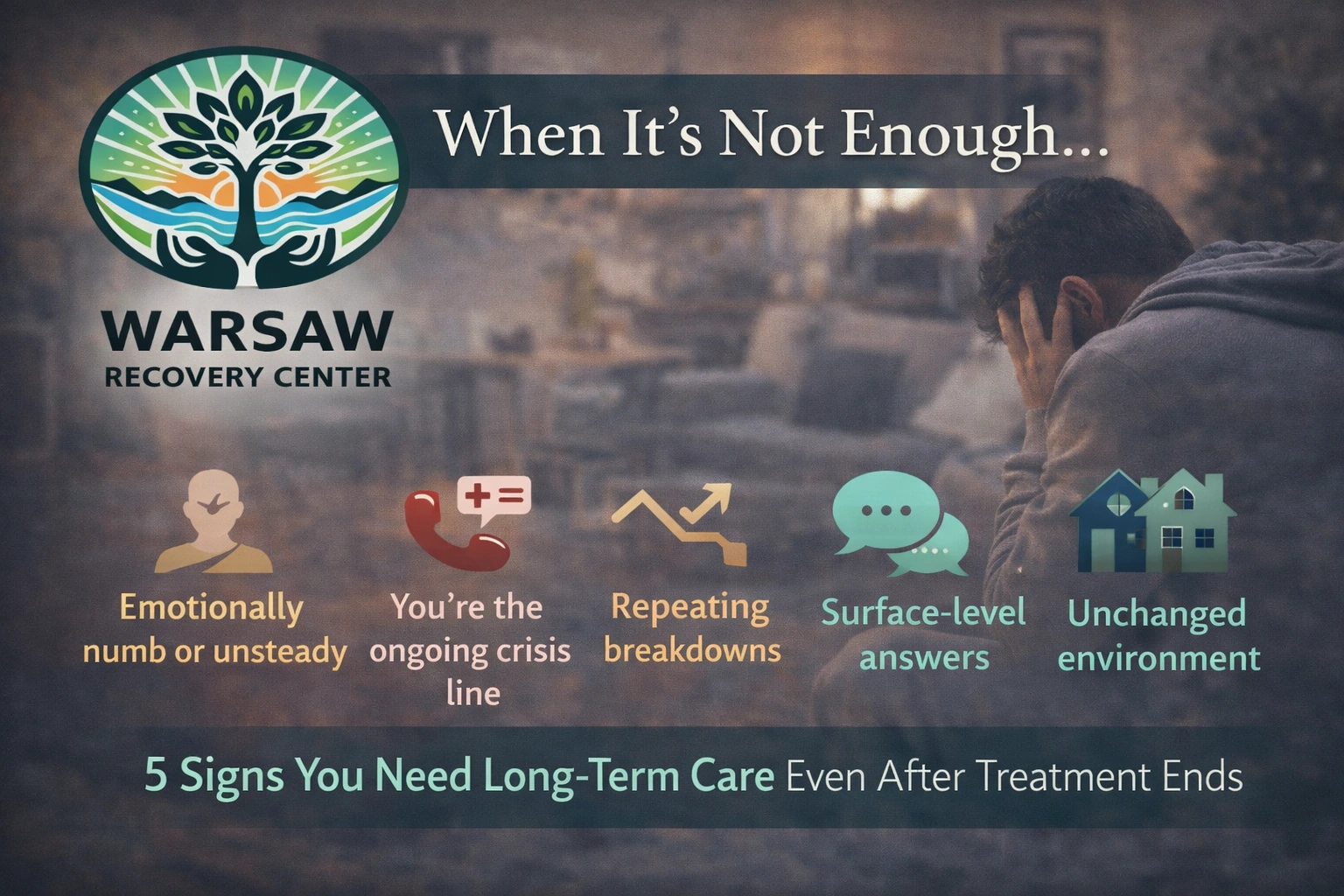
Everything Looks Good… Until It Falls Apart Again
You might notice a pattern. A few good days. A couple weeks where they seem okay. Then—crash.
The moods swing. They isolate. They explode. They vanish.
It might not even be about using again—it could just be that the pressure to seem recovered is too much. And because short-term treatment often focuses on immediate stabilization, there’s not enough time to explore the emotional roots or long-standing triggers underneath.
Long-term care makes space for that slow, necessary work. It doesn’t just fix behavior. It holds space for healing to stick.
They Say What You Want to Hear, But It Doesn’t Feel Right
Your child may be using all the right words:
- “I know my triggers.”
- “I’m staying busy.”
- “I’ve been journaling.”
But underneath, you can feel the script. The surface-level calm. The avoidance of deeper conversations.
This isn’t deception—it’s self-protection. It’s what people do when they’re afraid of falling apart and don’t know how to ask for more help.
We often hear this in early conversations with families in Williamsburg, Virginia. A mom told us, “He’s using all the language from treatment, but I can tell it’s rehearsed. It’s like he’s trying to convince himself more than me.” That’s a sign they need a space where they don’t have to perform recovery—they can actually experience it.
Their Environment Hasn’t Changed
Even if they’re not using, staying in the same surroundings can be dangerous. Old friends. Old routines. Easy access to stress and chaos.
For young adults especially, it’s hard to rewrite behavior in a place that taught them to survive through substance use. They need room to rebuild—not just physically, but emotionally.
That’s why many families explore options like live-in support or extended therapeutic programs—not as a punishment, but as a way to create a new foundation. Somewhere quiet enough to think. Strong enough to fail safely.
In some cases, families even choose to relocate care outside their immediate city for a while—not because they’re giving up, but because they’re finally prioritizing stability over familiarity.
They’re Avoiding Everything That Helped
If they’ve stopped showing up to therapy. If they’ve ghosted their sponsor. If every conversation feels like a shutdown—it’s not laziness or disinterest.
It’s often overwhelm.
When treatment ends, structure ends. And without someone helping manage the transition, even high-functioning young adults flounder.
One parent told us: “We made it through detox. But now? We’re alone again. And he’s slipping.” That disconnection doesn’t mean nothing worked—it means the scaffolding got pulled too soon.
Longer-term care helps rebuild it, brick by brick, with room to pause, reflect, and stabilize in real-time.
You’re More Exhausted Now Than Before Treatment
This is the one no one talks about.
The emotional crash after a crisis can be just as intense as the crisis itself. And if you’re feeling more tired now than when they were actively using, you are not alone.
When parents finally stop running on adrenaline, the grief hits. So does the confusion. The fear. The guilt. All of it. And if your child is still unstable, you’re being asked to push through without a break.
But you deserve one. So does your nervous system. And so does your child. Because healing should not require your constant sacrifice.
Frequently Asked Questions
How do I know this isn’t just a rough patch?
Sometimes it is a rough patch—but when they’re constant, recurring, and emotionally draining, it often signals something deeper. When “rough” becomes your new normal, it’s worth asking if more structured care is needed.
What if my child doesn’t want long-term care?
It’s a common roadblock. But resistance isn’t always refusal—it can mean fear, shame, or burnout. What helps: leading with love, offering options, and allowing professionals to have the hard conversations. You don’t have to carry that alone.
Isn’t long-term care just for “severe” cases?
Not at all. Long-term care is for people who need time, safety, and space to heal. Many people who look “high-functioning” from the outside are struggling privately. The goal is sustainability—not survival.
I’m afraid we’re out of chances. Is it too late?
No. It is never too late. We’ve worked with families who were on their third, fourth, even tenth attempt at structured care. What matters is what happens next. That’s the only part you can still shape—and we’re here to help with that.
What if I feel guilty about needing help?
That guilt is normal—but it’s also a signal that you’ve been carrying too much, for too long. Letting others step in isn’t giving up. It’s choosing recovery—for your child, and for yourself.
You Are Allowed to Ask for More
If your gut says this isn’t working—it probably isn’t.
You don’t need a diagnosis to seek longer-term care. You don’t need a relapse to justify help. You don’t need permission to say: “We need something that lasts this time.”
The goal isn’t just sobriety. It’s stability. Safety. A life that doesn’t revolve around crisis.
Call 888-511-9480 or explore our heroin addiction treatment in Richmond, Virginia to learn more. We’ll help you find the kind of support that lasts longer than the headlines, deeper than behavior, and stronger than fear.