Let’s be honest—getting sober young can feel awkward as hell.
You’re skipping parties, dodging the “just have one” comments, and quietly spiraling while your friends post bar selfies like it’s a personality trait. You want to feel better. You do. But you also kind of want to disappear when someone asks why you’re “not drinking tonight.”
If this is you, you’re not broken. You’re just early in the process.
And this is where a residential treatment program can help—not just by removing substances, but by helping you build a life that feels like yours. Not something you have to fake your way through. Not something you need to escape from.
1. You Stop Feeling Like the Only One
One of the loneliest parts of getting sober young is thinking you’re the only one doing it.
You look around and it feels like everyone your age is thriving off chaos. Bottomless brunches. Random hookups. 2 a.m. “you up?” texts that everyone pretends to laugh about the next day. And here you are, Googling “how to survive a Friday night sober” and wondering if you’ve aged out of your own generation.
In residential treatment, you realize something important: you’re not the only one.
You meet people who’ve also blacked out at birthdays they don’t remember, who’ve quietly quit five times already, who know the shame hangover better than the real one. People who understand why you feel weird, and help you realize maybe you’re not weird at all.
They’re not perfect. They’re just trying. Like you.
2. You Learn Why You Used (Not Just How to Stop)
White-knuckling sobriety doesn’t work long-term. You already know that.
You can delete the apps, change your number, go cold turkey, switch scenes—and still end up in the same cycle. Because until you understand why you were using, it’s just behavior control. Not actual healing.
A good residential treatment program like Warsaw Recovery Center helps you go deeper. You talk with therapists who don’t just ask “what happened?”—they ask “what hurt?”
Maybe it’s trauma. Maybe anxiety. Maybe something you’ve never put into words. Whatever it is, once you name it, you can stop running from it. That’s when recovery starts feeling like freedom instead of a punishment.
3. You Build Coping Skills That Actually Fit Your Life
Let’s be real: not every early recovery suggestion makes sense when you’re young. “Go for a walk.” “Drink tea.” “Call a sober buddy.”
Okay, but what if your roommate’s throwing a rager and your anxiety’s louder than the bass?
That’s why residential treatment matters. You learn skills that actually apply to your life. Not just generic slogans.
You’ll practice:
- What to do when you feel everything all at once and nothing at all
- How to respond to group chats about weekend plans without isolating
- How to sit through boredom without reaching for a crutch
- How to tell your friends you’re sober without making it weird
Think of it like a life bootcamp—but with group therapy, supportive people, and actual rest.
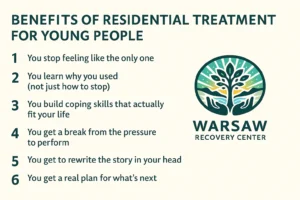
4. You Get a Break From the Pressure to Perform
Being young comes with this weird pressure to have it all figured out. Degree. Job. Friends. Adventures. A cute pet and a gym routine by 24.
Add sobriety on top, and suddenly you’re trying to be a full-time human while healing from something most people pretend doesn’t exist.
In treatment, you get a break from that. You don’t have to perform. You don’t have to smile when you don’t want to. You don’t need a five-year plan or a wellness brand. You just need to show up. Breathe. Be honest.
The expectations shrink so your actual self can emerge. It’s not about achievement—it’s about recovery. And that’s enough.
5. You Get to Rewrite the Story in Your Head
You know that voice in your head that says:
“You’re broken.”
“You’ll never have fun again.”
“No one will understand.”
Yeah, it lies.
In residential treatment, that voice gets challenged—not by force, but by reality. Every time you make it through a day without using, it weakens. Every time someone laughs at your joke in group, it crumbles. Every time you realize you can feel joy or calm or pride without substances, it quiets down.
You start replacing those scripts with new ones. Stuff like:
“I can do hard things.”
“I’m not boring—I’m just present.”
“There are people who get me.”
Recovery isn’t about becoming a new person. It’s about unlearning the lies that told you the old you wasn’t enough.
6. You Get a Real Plan for What’s Next
One of the scariest parts of getting sober is wondering: what now?
What happens when treatment ends? What happens when you go back to real life with its triggers and TikToks and temptations?
Warsaw Recovery doesn’t just send you back into the world with a “good luck.” From the start, they help you create a plan. That could include:
- Outpatient therapy
- Sober living support
- Rebuilding school or work structure
- Connecting to peer groups that aren’t culty or awkward
- Knowing who to call when the feelings hit hard
Because you’re not just staying sober. You’re building a life that doesn’t require a reset button every weekend.
FAQ: Residential Treatment for Young People at Warsaw Recovery Center
Is a residential treatment program really necessary if I’m young?
Yes—especially if you’ve already tried to cut back and couldn’t, or if your mental health is suffering. Age doesn’t make your pain less real. If substances are interfering with your life, you deserve support.
Will I be the youngest person there?
Not necessarily. Warsaw Recovery Center works with people across age ranges, and many clients are in their 20s or early 30s. Staff are experienced in making sure everyone feels seen and respected.
Can I keep going to school or working while in treatment?
Residential treatment is immersive, which means you step away from school or work temporarily to focus fully on recovery. But it’s not the end—it’s the beginning of something stronger. We help you make a plan to return with clarity and support.
Will it be all rules and no freedom?
There’s structure—but it’s designed to make you feel safe, not trapped. The schedule includes therapy, rest, activities, and free time. It’s not a punishment. It’s a pause.
What if I don’t feel “addicted enough”?
You don’t have to hit rock bottom to ask for help. If you’re reading this and thinking “Maybe I need something like this,” that’s already enough reason to reach out.
You don’t have to figure this out alone.
Call (888) 511-9480 to learn more about our Residential Treatment Program services in Warsaw, Virginia. Sobriety doesn’t have to be weird—and neither do you. There’s a place where people get it. We’ll meet you there.