
I looked like I had it together. Inside, I was unraveling.
I never got sloppy. I never drank before noon. I hit deadlines, paid bills, showed up. From the outside, I looked like a guy who knew how to handle his life. But every night, that first glass of wine stopped being a treat—and started being a lifeline.
Then it turned into a leash. Then a cage.
If that sounds dramatic, I get it. I would’ve rolled my eyes too. Until I realized I hadn’t gone a single evening without drinking in months—and I couldn’t imagine stopping without my body or my mind falling apart. That’s when I found alcohol detox at Warsaw Recovery Center—and it changed everything.
I Was Still “Functioning,” But I Wasn’t Living
We don’t talk enough about the middle ground. The people who aren’t drinking in alleyways or losing jobs—but who can’t get through a Tuesday without a buzz.
That was me. I had a decent job. A relationship. Friends. Nobody was worried about me. Hell, most people drank like me—or so I told myself.
But slowly, alcohol became non-negotiable. I didn’t relax with a drink—I couldn’t relax without one. I was no longer drinking to enjoy myself. I was drinking to feel normal. And I was terrified to stop.
The Night It All Came Crashing Inward
It wasn’t a dramatic rock bottom. There was no big confrontation, no DUI, no lost job. Just one night, I woke up soaked in sweat, heart pounding like a drum solo, hands trembling so badly I couldn’t hold my phone.
I wasn’t hungover. I was in withdrawal.
And in that moment, I knew—this wasn’t something I could “tough out.” This wasn’t a long weekend of green juice and Netflix. This was medical. This was dangerous.
Alcohol Detox Wasn’t Rock Bottom—It Was a Turning Point
I typed “alcohol detox Virginia” into my browser and found Warsaw Recovery Center’s alcohol detox program. I called. I expected shame. I expected suspicion. Instead, I got calm.
They didn’t ask me why I drank. They didn’t ask me to justify my “high-functioning” life. They just said: “You’re safe now. We’ll help you stabilize.”
And they did.
Detox Didn’t Punish Me. It Gave Me a Place to Breathe.
It wasn’t a hospital. It wasn’t cold or harsh. Warsaw’s detox felt more like a retreat than a sentence. I was monitored. I was medicated when I needed it. I was listened to.
The physical symptoms came and went—sweats, tremors, nausea. But the emotional symptoms? Those were heavier: guilt, fear, the shaky relief of not being alone anymore.
But here’s the thing: detox didn’t demand anything of me. It gave me space. I didn’t have to perform. I didn’t have to fix everything. I just had to be there—and let the professionals hold what I couldn’t.
I Didn’t Lose Everything—But I Was Losing Me
That was the scariest realization. Not that I might get caught. But that I’d already lost myself. I couldn’t remember the last time I felt fully present. I was moving through life like a cardboard cutout—laughing on cue, pretending to care, waiting for 5 o’clock.
When I sobered up in detox, I saw clearly: I was surviving. But I wasn’t thriving. And no title, no paycheck, no social calendar could make up for the fact that I hadn’t felt joy—or peace—in a very long time.
High-Functioning Doesn’t Mean Healthy
We like to believe that success cancels out suffering. That if we’re performing, we’re fine. But alcohol doesn’t care about your calendar. It doesn’t care if your resume looks sharp. It slips into the spaces between pressure and exhaustion, between anxiety and applause.
And when you realize it’s taken more than it ever gave, it’s already become your safety blanket—and your captor.
Detox helped me cut the cord.
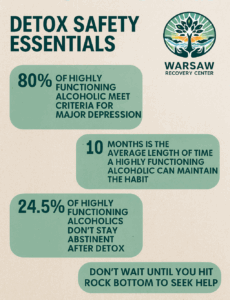
Warsaw’s Alcohol Detox Program Respected Me
That mattered more than I can say. I didn’t want to be treated like a criminal. I didn’t want to be babied. I wanted to be taken seriously. And at Warsaw Recovery Center, I was.
Their alcohol detox in Virginia program is built for adults who are scared but ready. People like me—who didn’t think they fit the “alcoholic” mold but couldn’t lie to themselves anymore.
I was treated like a man with a problem, not a problem pretending to be a man.
Detox Wasn’t a Cure—But It Was a Catalyst
Let me be clear: detox didn’t fix everything. But it unstuck me. It got me out of the loop. It gave me a few solid days to rest, stabilize, and actually consider what life without alcohol could feel like.
It was the first honest pause I’d had in years. No pretending. No white-knuckling. Just a reset.
And from there? I made the next choice. And then the next.
FAQs: What You Should Know About Alcohol Detox
Do I have to be drinking 24/7 to need detox?
No. If you’ve tried to cut back and felt sick, shaky, or mentally unstable—you may be experiencing withdrawal. That’s a medical issue, not a moral one. And it’s a valid reason to seek detox.
Is detox going to be painful or traumatic?
Not at Warsaw. Their team uses medication-assisted protocols to ease discomfort and manage risk. Most people feel significantly better within a few days.
How long does detox last?
Most alcohol detox programs last 3–7 days. Your length of stay depends on your medical needs, drinking history, and how your body responds.
Will this stay on my record or affect my job?
Your stay is confidential. Warsaw Recovery Center protects your privacy, and many clients use personal time, sick leave, or FMLA to attend detox.
What happens after detox?
You’ll work with staff to explore next steps—whether that’s outpatient treatment, therapy, or community support. Detox is the first step, not the last one.
You Don’t Have to Keep Pretending
If you’re waking up tired, hiding bottles, planning your day around drinking—and no one knows—you’re not alone. And you’re not hopeless.
There’s another way to live. I found mine in a detox room that didn’t ask me to prove how bad it had gotten. They just helped me feel human again.
Ready to stop just surviving?
Call (888) 511-9480 to learn more about our alcohol detox services in Warsaw, Virginia. It’s not too late. It’s just time.