You don’t remember when it flipped.
At first, substances felt like magic. A portal. An unlocking. They didn’t just blur edges—they sharpened them. You weren’t escaping. You were entering something deeper. And for a while, it worked.
Until it didn’t.
Maybe now, it feels like you’re borrowing energy that never quite comes back. Maybe the things you used to write, say, build, or feel… they’re harder to reach. And when they do come? It’s all tangled up in shame, exhaustion, or a kind of fog you can’t quite explain.
If you’re reading this, you’re probably not asking, “Do I have a problem?” You’re asking, “What if sobriety takes me away from myself?”
This blog is for that fear.
And if you’re here, we want you to know: it’s a real fear. And it’s also survivable. More than that—it’s navigable. Substance use detox doesn’t erase your identity. It makes space for it.
You’re Not Being Dramatic. You’re Grieving a Version of Yourself.
Let’s start here: the substances meant something.
They didn’t just numb you—they connected you.
To people. To ideas. To the version of yourself who could say things out loud.
So the idea of detoxing isn’t just physical—it feels like giving something up.
And that’s real. You’re not weak for mourning it.
But it’s worth asking: what exactly are you mourning?
Is it the substance?
Or the version of you that felt more alive when you used it?
Because here’s what we’ve seen, again and again: the aliveness wasn’t fake. It was yours. And it’s still in there—buried under withdrawal, anxiety, shame, and a cycle that’s probably gone on longer than anyone knows.
You didn’t make this up. But you can make something new from it.
The Edge Isn’t Gone. It’s Waiting.
People use substances for all kinds of reasons. But for creative and identity-focused folks, one reason shows up a lot: they’re trying to stay in contact with the rawness of life.
And that makes sense.
But here’s what’s harder to see from inside the fog: over time, substances don’t amplify your edge. They corrode it. The more you use, the harder it becomes to tell what’s real. You’re not feeling more—you’re feeling through something.
And that thing starts filtering everything.
When you stop using, that edge doesn’t disappear. It just changes. It stops being driven by chaos and becomes rooted in clarity.
You don’t lose access to your voice. You lose access to the static that’s been hijacking it.
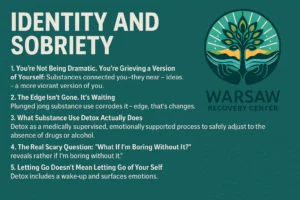
What Substance Use Detox Actually Does
Let’s demystify the word.
“Detox” gets thrown around like it’s a juice cleanse or a punishment. It’s neither.
At Warsaw Recovery Center in Virginia, substance use detox is a medically supervised, emotionally supported process that helps your body safely adjust to the absence of drugs or alcohol. It’s the beginning, not the end.
Here’s what happens in our detox program:
- Medical stability is prioritized so you’re safe and monitored 24/7.
- Withdrawal symptoms are managed with compassion, not judgment.
- Emotional support is built in—so you’re not just lying in a room “riding it out.”
We know detox isn’t just physical. It’s identity-level. And we treat it that way.
Learn more about our Substance Use Detox program in Warsaw, Virginia
The Real Scary Question: “What If I’m Boring Without It?”
Let’s say it out loud: you’re not just afraid of withdrawal.
You’re afraid you’ll lose your fire.
The part of you that’s unpredictable, magnetic, funny, intense, interesting.
You might not even like all those parts—but you know them.
And you’re scared that without substances, you’ll flatten. Fade. Become one of those people who only talks about wellness and sleep schedules.
Here’s what you’re not hearing enough:
Sobriety doesn’t sterilize you. It reveals you.
And the parts of you that lit up on substances? They didn’t come from the substance. They came from you.
Detox is what lets them breathe without burning you down.
Letting Go Doesn’t Mean Letting Go of Your Self
Here’s a secret: most people don’t feel like themselves in early detox.
That’s not failure. That’s healing.
Your brain is recalibrating.
Your nervous system is adjusting.
Your emotions are surfacing—sometimes all at once.
It’s disorienting because substances numbed and elevated and soothed all at once.
Without them, everything feels… raw.
But that rawness? It’s not the problem. It’s the sign you’re waking up.
And on the other side of that—there’s room.
For your relationships.
For your attention span.
For the parts of your creativity that don’t just perform pain, but create from wholeness.
Detox Doesn’t Have to Be Cold or Clinical
We’ve all seen the horror-movie versions of detox: cement walls, sterile beds, no one talking to you unless you press a button.
That’s not how we do things in Warsaw.
Our detox program was built for people who feel deeply and need to be treated like whole humans—not just a body in withdrawal.
That means:
- Staff who speak to you like a person.
- Therapists who get the fear of identity loss.
- Supportive programming that prepares you for next steps—not pressures you.
It’s not fancy. But it’s human. And that matters more.
You Can Still Be You Without the Substances
You might be wondering, “But who will I be?”
That’s the scariest question—and the most hopeful one.
Because here’s what we’ve seen:
- The guy who thought he could only perform while high? He found his voice again—and it was richer.
- The woman who thought alcohol made her social? Turns out, she was funny because of how she sees the world—not because of the wine.
- The songwriter who couldn’t write without opioids? She started writing differently. Slower. But deeper. And people felt it.
You don’t become someone else in detox.
You just finally meet the version of yourself who’s been buried under survival.
When You’re Ready, We’re Here
You don’t have to be “rock bottom.”
You don’t need the right words.
You just need to be willing to ask, “What if this could get better?”
That’s enough.
At Warsaw Recovery Center, we meet people exactly where they are. No theatrics. No judgment. Just steady, evidence-based, human-centered detox support in a place that sees the person behind the pain.
Frequently Asked Questions About Substance Use Detox
What is substance use detox?
Substance use detox is the medically supervised process of removing drugs or alcohol from your body while managing withdrawal symptoms. At Warsaw Recovery Center, we provide compassionate care with 24/7 support during this phase.
How long does detox take?
Detox typically lasts between 3 to 10 days, depending on the substance, how long you’ve been using, and your physical health. Our team assesses you individually to guide your timeline safely.
Will detox affect my creativity or personality?
Detox doesn’t erase who you are. It may feel like you’re losing part of yourself at first, but many people find that their creativity returns more clearly once the fog lifts. You might feel different—but not less.
Do I have to go to rehab after detox?
We strongly recommend continuing care after detox. Detox is just the first step. Many people benefit from transitioning into a residential or outpatient program for deeper healing.
Is detox safe to do at home?
For most substances, especially alcohol, benzos, or opioids, detoxing at home can be dangerous. Medical detox is the safest option and gives you the best foundation for recovery.
Ready to take the first step?
Call (888) 511-9480 to learn more about our Substance Use Detox services in Warsaw, Virginia. We’ll meet you where you are.