There’s a specific fear that doesn’t get talked about enough. Not the fear of withdrawal. Not the fear of what people will think. Not even the fear of failure.
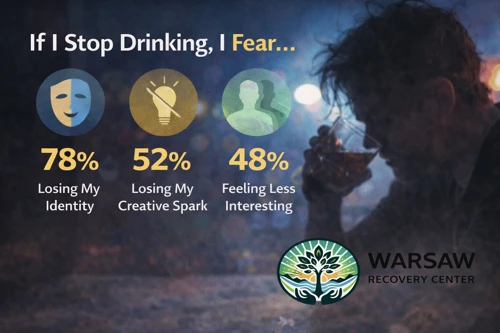
It’s the fear that if you stop drinking, you’ll stop being you.
If alcohol helped you come out of your shell, be more creative, more alive, more interesting—or at least, that’s what it felt like—then the idea of treatment can feel like walking into a room and being asked to leave yourself at the door.
At Warsaw Recovery Center, we understand this fear. And we don’t ignore it or minimize it. We meet it head-on. Because when alcohol has become part of how you relate to the world—and yourself—stepping away from it doesn’t feel like quitting a substance. It feels like amputating part of your identity.
But here’s the truth: treatment doesn’t take your identity away. It helps you come back to the version of yourself that alcohol promised but couldn’t deliver.
You can learn more about our alcohol addiction treatment program here.
It’s Not Just About Drinking—It’s About Who You Are When You’re Drinking
If you’ve used alcohol to loosen your tongue, fuel your art, flirt more boldly, dance without fear, or quiet the storm in your head… of course you’re scared to stop.
Because alcohol didn’t just give you a buzz. It gave you access.
To expression. To freedom. To flow. To the version of yourself who doesn’t overthink every word, every movement, every breath.
And yet… the trade-offs have gotten harder to ignore.
- You wake up foggy when you used to wake up inspired.
- You forget conversations you meant to hold onto.
- Your rituals start to look more like dependence than expression.
- The thing that once freed you now demands you.
It’s a hard shift to name, but once you see it—you can’t unsee it.
You’re Not Broken for Being Afraid
Most people think of alcohol addiction treatment as a physical or behavioral fix. But for many, especially creatives, the real fear isn’t about cravings. It’s about loss of identity.
Who will I be without this?
What if I’m boring?
What if I can’t write? Can’t paint? Can’t connect?
What if the most interesting parts of me disappear?
These are not silly fears. They’re deeply personal, deeply rooted, and absolutely valid. At Warsaw Recovery Center, we work with people every day who come in carrying this exact weight. They aren’t just trying to stop drinking—they’re trying to find out if there’s anything left without it.
And what they discover, time and again, is that they are still in there. Just… quieter. Waiting. Ready.
Treatment Isn’t a Blank Slate—It’s a Mirror
A lot of people worry that treatment will make them a sanitized version of themselves. That it’ll replace passion with politeness, edge with etiquette, personality with blandness.
But real alcohol addiction treatment doesn’t scrub your personality out. It reflects it back to you—more clearly.
You begin to see what alcohol was pretending to do—and what you’re capable of doing without it.
- The connection? Still possible. More real.
- The creativity? Still alive. Less forced.
- The spontaneity? Still accessible. Without regret the next morning.
And the confidence that used to arrive with a glass in hand? It’s still yours. Just less fragile. Less fleeting.
Grieving the “Drunk You” Is Part of the Process
Here’s something we don’t say enough: You’re allowed to miss the version of yourself you were when you were drinking.
You can grieve her. Or him. Or them.
The version that was funnier. Wilder. Less anxious. Less self-conscious. The version that lit up at parties or wrote five poems at midnight with a bottle nearby.
That version existed for a reason. They helped you survive things. Navigate life. Get through.
But they also made you pay. With sleep. With memory. With mornings full of shame or self-doubt. With nights that slipped too far out of control.
You can honor who you were without romanticizing who you no longer want to be.
Grief doesn’t mean you’re making the wrong choice. It means you’re releasing something that used to feel like home—even if it was hurting you.
You’re Not Losing Your Spark. You’re Reclaiming It.
The biggest lie alcohol tells creatives and identity-driven people is this: You need me to be interesting.
But what if the truth is… you were always interesting?
What if alcohol just dulled the parts of you that didn’t need to be dulled?
What if treatment doesn’t dim your light—but helps you burn steadier, brighter, longer?
We’ve seen it happen. Again and again.
Clients from Fredericksburg, Virginia and Williamsburg, Virginia have told us they were terrified they’d become shells of themselves in sobriety. But instead, they became fuller versions of themselves—still funny, still wild, still deep—just clearer. More present. More powerful.
Not erased. Just reconnected.
What Alcohol Addiction Treatment Really Offers
At Warsaw Recovery Center, we don’t expect you to walk in ready to surrender your identity. We know this is personal. Intimate. Scary.
That’s why our program is built to support your full self:
- Medically supported detox, if needed, to make the first days manageable
- Trauma-informed therapy that respects your story, not just your symptoms
- Creative and expressive modalities—art, music, movement—designed to give you access to yourself again
- Mental health support for anxiety, depression, or the deeper emotional currents that alcohol may have been masking
- No pressure to become someone else—just support for rediscovering who you’ve been all along
We don’t believe in generic recovery. We believe in personal reclamation.
You Don’t Have to Commit to Forever—Just Be Curious About Tomorrow
The idea of never drinking again might feel impossible right now. That’s okay.
You don’t have to sign up for forever. You don’t even have to be sure this is what you want.
You just have to be curious.
Curious about what it might feel like to write sober.
To laugh and remember it.
To wake up clear.
To feel all the way through something instead of numbing halfway out of it.
Curiosity is enough to begin.
FAQs: For the Creative, the Performer, the Identity-Driven Soul
What if alcohol is tied to my creativity?
That’s one of the most common fears we hear. Many people discover that their creative process doesn’t disappear in sobriety—it deepens. We use expressive therapies to help reconnect you to that flow without relying on alcohol to get there.
I don’t want to become “boring.” Will that happen?
No. You’re not boring without alcohol—you’re just unmasked. In treatment, you’ll have space to explore what makes you feel alive and connected, without relying on alcohol to access it.
What if I’m not ready to say I’m an alcoholic?
You don’t need to wear a label to get help. If alcohol is causing more pain than relief, that’s enough. We focus on your goals, your experience, and what healing looks like for you.
Will I lose my sense of self in treatment?
No. In fact, most people report feeling more like themselves in recovery. That includes humor, wit, creativity, spontaneity, and presence—without the haze or regret.
Can I still be around people who drink?
Eventually, yes—but not immediately. Part of treatment includes building new boundaries and learning how to protect your energy. Over time, you’ll decide what environments are safe and which aren’t worth the cost.
If you’re afraid that treatment might erase the most important parts of you, you’re not alone—and you don’t have to figure it out alone. Call (888) 511-9480 to learn more about our alcohol addiction treatment in Richmond, Virginia.