
You’re not overreacting. You’re not being dramatic. You’re watching your child spiral—and no one gave you a manual for what this part of parenting would feel like.
Maybe the drinking was the first sign. Or maybe it was the last in a long string of gut-check moments: the empty eyes, the blown-off plans, the long silences, the wild swings between high energy and complete shutdown. Maybe they say they’re fine. Maybe they’ve stopped saying anything at all.
What you know is this: your son or daughter is not okay. And it’s more than just the alcohol.
At Warsaw Recovery Center, we meet families in this exact moment—scared, unsure, and desperate to help without pushing their child further away. Our alcohol addiction treatment program is designed not just to address drinking behavior, but the mental health challenges and emotional pain that often drive it.
It’s Not Just the Alcohol—And It Never Was
When alcohol enters the picture, it becomes the most obvious thing to blame.
But most parents can feel that the real story goes deeper. You might have noticed signs before the drinking ever got bad:
- Sudden mood swings or outbursts that didn’t make sense
- School avoidance, dropping grades, or disconnection from longtime friends
- Panic attacks, sleepless nights, or days spent completely shut down
- Hyper-fixation on perfection—or zero motivation at all
- Moments where you couldn’t even recognize your own kid
Alcohol often isn’t the root. It’s the coping mechanism. The way they try to manage anxiety, numb depression, forget trauma, or avoid shame. And for many young adults, that pattern forms fast and early.
That’s why treatment has to go beyond behavior management. Because if you only address the drinking without healing the mental and emotional pain underneath it, the cycle comes back.
Mental Health and Alcohol Use Are Deeply Connected
Your child might be struggling with:
- Generalized anxiety disorder
- Social anxiety or panic
- Depression or bipolar disorder
- PTSD from childhood or recent trauma
- ADHD or executive dysfunction that’s gone undiagnosed
And sometimes, you don’t get a clear diagnosis right away. What you see instead is dysregulation—nights of staying up until 5am, sudden withdrawals from commitments, constant irritability, extreme highs and lows, or an inability to function under normal expectations.
In the absence of coping tools or support, alcohol often becomes the thing that “works.” Until it doesn’t.
And then the fear sets in. For them—and for you.
Real Alcohol Addiction Treatment Includes Real Mental Health Support
At Warsaw Recovery Center, we don’t separate addiction from mental health. Our program is built on the understanding that one can’t heal without the other.
That’s why every client receives:
- Dual diagnosis treatment, where both substance use and mental health symptoms are treated together
- Clinical assessments that look beyond surface behaviors to understand emotional, psychological, and social factors
- Individual therapy with licensed professionals who specialize in co-occurring disorders
- Group therapy that reduces shame and builds connection
- Medication support, when appropriate, to stabilize mood or reduce anxiety
- Family engagement, because you’re a vital part of their healing
We treat the whole person. Not just the substance use. Not just the diagnosis. But the human being underneath both.
You Don’t Need a Diagnosis to Know Something’s Wrong
Many parents hesitate to reach out because they’re not sure what they’re dealing with.
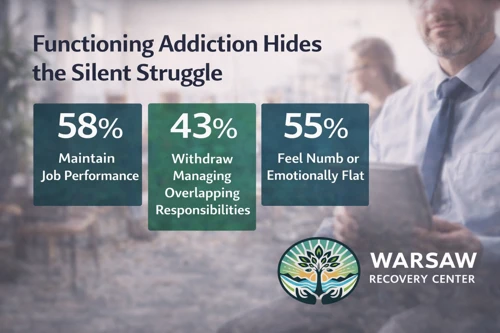
Maybe your child hasn’t been formally diagnosed. Maybe they won’t admit there’s a problem. Maybe they’re still “high-functioning”—holding a job, going to class, or masking well enough that others don’t see it.
But you do. You know what they were like before. You know what they’re capable of. You can feel the difference—even if you can’t explain it.
You don’t need a diagnosis to justify concern. You don’t need proof that they’re an alcoholic to explore treatment. If your gut says they’re drowning, we’ll help you figure out what’s underneath the surface.
You’re Not Failing Them by Setting Limits
One of the hardest parts of being a parent in this situation is the guilt.
- Guilt for wondering if you caused it
- Guilt for saying too much—or not enough
- Guilt for letting them stay home, or making them go
- Guilt for considering treatment
But here’s the truth: loving someone means sometimes saying no more.
Not as punishment. Not to control them. But because your job isn’t to rescue them—it’s to protect their chance to get help.
And sometimes, the most loving thing you can do is draw a boundary. To say, “I love you too much to let this keep happening without support.”
We help families walk that line—with compassion, firmness, and structure that holds everyone safely.
What Treatment Actually Looks Like
We know you’ve got questions. Treatment can feel like a black box if you’ve never been through it.
At Warsaw Recovery Center, here’s what you and your child can expect:
- Safe, supportive detox if withdrawal is needed
- Residential or outpatient care depending on severity and readiness
- Mental health assessments and personalized treatment plans
- Education about substance use, triggers, and healthy coping
- Medication management when indicated (never forced)
- Family therapy to rebuild trust and improve communication
- Aftercare planning to support transition back into school, work, or home life
We work with young adults at all stages—those who are resistant, those who are terrified, and those who don’t know what they want but know this isn’t it.
This Is Hard. But You’re Not Alone.
You may feel like you’re the only parent going through this. But you’re not.
We’ve worked with families from Fredericksburg, Virginia and Williamsburg, Virginia, and many said the same thing when they called: “We’re out of options.” “We don’t know what to do next.” “We’re afraid of what might happen if we don’t act soon.”
These aren’t just treatment decisions. They’re life-and-death, mental-health-and-safety decisions.
You deserve support too.
We’ll help you understand the options, make a plan, and move forward—even if things still feel messy. Especially then.
FAQs for Parents Navigating Alcohol and Mental Health Crises
What if my child doesn’t believe they have a problem?
This is common. Many young adults use denial as protection against shame. Our team is trained in motivational interviewing and compassionate engagement—we meet resistance without force.
Can you treat mental health and substance use at the same time?
Yes. That’s the foundation of our approach. We treat both simultaneously with a coordinated care team that communicates and collaborates daily.
Will they have to take medication?
Not unless it’s clinically indicated and agreed upon. Meds are one tool—never a requirement. We always center consent and education in the process.
What if they leave treatment early?
We don’t see that as failure. We stay connected, keep the door open, and work with families to re-engage them when they’re ready. Treatment is a process, not a one-time fix.
How involved can I be as a parent?
As much as is appropriate and helpful. We provide regular updates, family therapy sessions, and education to support your role—without overstepping your child’s agency.
If your child is struggling and you know it’s more than just alcohol, we’re here to help. Call (888) 511-9480 to learn more about our alcohol addiction treatment in Richmond, Virginia.