You’ve been holding on. Watching. Hoping.
You told yourself it was just a phase. That things would calm down once school ended, or work picked up, or the friend group changed. But the patterns haven’t shifted—and now, they’re starting to escalate.
If your 20-year-old is using again, lying again, shutting down again—you’re likely here because your gut won’t let you ignore it anymore.
And while you’re not sure what the next step is, you’re starting to ask a hard, necessary question: Is it time for residential care?
At Warsaw Recovery Center, we’ve walked this road with hundreds of families. And as a clinician, I want to say something clearly: you’re not overreacting. You’re responding to real, painful patterns—and it’s okay to want more support.
When Safety Is the Concern, It’s No Longer “Just a Phase”
Parents can tolerate a lot—missed curfews, eye rolls, messy rooms. But when safety becomes a real concern, something changes.
Here’s what that can look like:
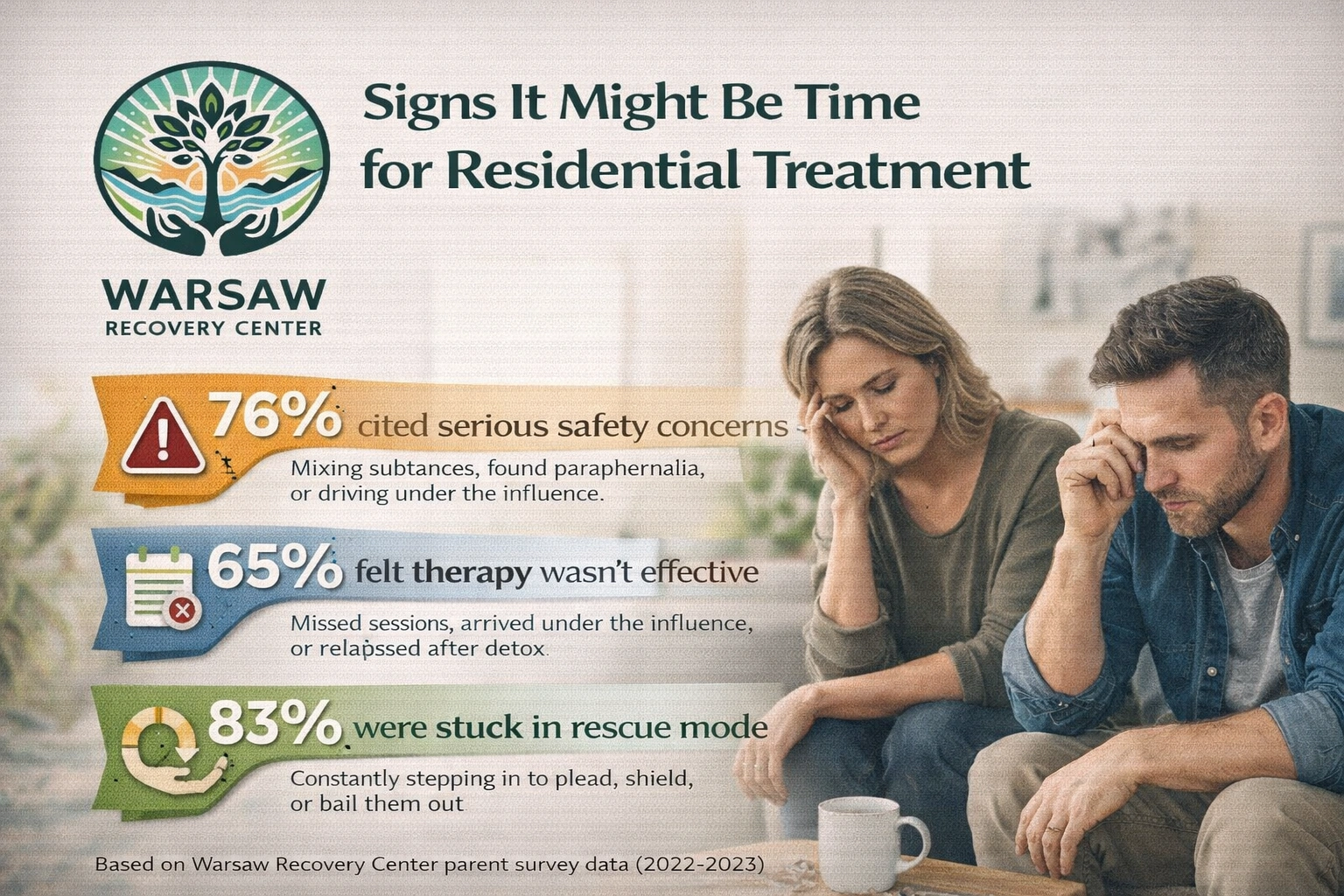
- Your child is mixing substances, taking risks they never would have before.
- You’ve found paraphernalia, empty bottles, or seen signs of overdose.
- They’re driving under the influence, or leaving the house at all hours.
- You’re scared to go to sleep. You check their breathing. You keep your phone ringer on at night.
A residential treatment program becomes necessary when the risk outweighs the rhythm of everyday life. When home is no longer a safe or structured enough place to keep your child—and you—out of crisis.
When Therapy Isn’t Working Anymore
You’ve tried outpatient therapy. Maybe IOP. Maybe even short detox programs. You’ve done your part—helping them find therapists, offering rides, reminding them of appointments, maybe even paying for services out-of-pocket.
But here’s what many parents discover:
If you’re working harder than they are, something needs to change.
When your child:
- Shows up to therapy high
- Skips group sessions and lies about it
- Treats treatment like a checkbox, not a commitment
- Gets just well enough to convince you they’re fine—but then spirals again
…it might be time to pause and ask whether the level of care is matching the level of need.
A residential treatment program offers what outpatient can’t: a full environment shift. A reset. Time away from triggers, influences, and access to substances. Time for therapy to land deeper, without daily chaos pulling them back.
When Your Love Has Turned Into Rescue
This one’s the hardest to admit.
We love our kids so much that we start doing everything for them—until love becomes a kind of soft rescue that doesn’t lead to change.
Maybe you:
- Make excuses to teachers, bosses, or extended family
- Bail them out—literally or emotionally
- Hand over money with one hand and set a boundary with the other
- Let go of your own needs because you’re afraid they’ll spiral without you
You are not a bad parent. You are a parent who’s been doing everything you can.
But treatment is what happens when your help isn’t helping anymore.
Residential care gives your child a chance to step into accountability—with professionals who can support, challenge, and guide without the emotional weight that parents carry.
When the Person You Raised Isn’t Who You’re Seeing Anymore
Substance use doesn’t just change behavior. It changes identity—at least on the surface.
You might be seeing:
- A sharp, creative young adult suddenly unable to hold a conversation
- A formerly social child withdrawing, lying, or lashing out
- A sweet, funny spirit now defensive, secretive, and emotionally shut down
And in between, moments where the real them still flickers through—which makes it even harder.
Parents in Fredericksburg, Virginia have told us they feel haunted by that flicker. They say things like, “I saw her smile the other day, like she used to. And then she disappeared again.”
That flicker matters. It’s a sign that your child is still in there. But they may not be able to find their way back on their own.
When You’re More Afraid of Doing Nothing Than Doing “Too Much”
This is the tipping point.
You’ve avoided making “too big a deal” of things. You didn’t want to push them away. You’ve tried keeping the peace.
But now? Now you’re waking up with a heavier heart.
Now, the fear of waiting too long is louder than the fear of overreacting.
That’s when it’s time.
Not when things get perfect. Not when you’re totally sure. But when you’re ready to try something different—because what’s happening now isn’t working.
What a Residential Treatment Program Actually Offers
At Warsaw Recovery Center, we build residential care around connection, safety, and clinical insight. This isn’t a lockdown facility. It’s a healing container.
Your child will receive:
- 24/7 support from trained staff who specialize in substance use and co-occurring disorders
- Daily clinical care, including group and individual therapy
- Skill-building, from emotional regulation to relapse prevention
- Wellness support, including nutrition, sleep, and movement
- Family integration, where appropriate, to support reconnection without codependence
- Discharge planning so you and your child know what comes next
It’s not about fixing them. It’s about giving them space to find themselves again—and tools to navigate what comes after.
What Parents Often Ask (and Need Honest Answers To)
What if my child says they don’t need treatment?
That’s common—especially with young adults. We’ll help you navigate this conversation and offer strategies for introducing treatment as an option that protects their freedom long-term, not limits it.
Is it really necessary if they’re only using “softer” drugs like weed or alcohol?
If the use is chronic, escalating, or impairing their functioning—yes. The drug doesn’t have to be hard for the impact to be.
What if they’ve already been to treatment once?
Relapse doesn’t mean failure. It means more support is needed. A second (or third) round of care can go deeper, especially when your child is older, more open, or has different life context.
How long will they be gone?
Most residential programs last 28 to 45 days. We personalize timelines based on clinical assessments, progress, and discharge goals.
What if I can’t keep paying for treatment?
We accept many insurance plans and can guide you through options for affordable care. Don’t let cost stop you from reaching out.
When It’s Time, You’ll Know. But You Don’t Have to Decide Alone.
You don’t need a perfect diagnosis. You don’t need to know exactly what’s next. You just need to trust that the voice inside you—the one saying this is too much to carry alone—is worth listening to.
Let’s figure it out together.
Explore our residential treatment program and see what’s possible when the right support is finally in place.
Call (888) 511-9480 to learn more about our Residential treatment program in Richmond, Virginia.