You’ve got it handled.
That’s what you keep telling yourself. And in a lot of ways, it’s true. You’re getting things done. You’re showing up. You’re not unraveling. But what most people don’t see is the quiet math you’re doing every day to make it look that way:
How many pills will get me through this meeting without sounding flat? Will anyone notice if I refill early again? If I skip dinner, will the wine hit faster?
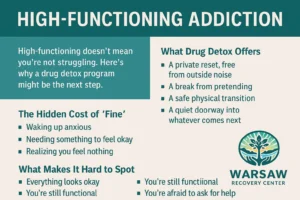
High-functioning doesn’t mean you’re not struggling. It just means you’ve learned how to hide it better than most.
If you’re starting to wonder whether it’s time to stop, that’s not weakness talking. That’s clarity breaking through. And a drug detox program might be exactly what gives that clarity the space it needs to grow.
The High-Functioning Profile: Quietly Drowning in Plain Sight
The stereotype of addiction is loud—chaotic, messy, visibly unraveling. But you’re none of those things. You’re a parent, a leader, a student, a caregiver. You’re “fine.”
Until you’re not.
For high-functioning individuals, the outside doesn’t always reflect the inside. You might look like you have it together while managing a level of emotional and physical strain that would undo most people.
And because the world still claps when you perform, it’s easy to believe your addiction “isn’t that bad.” But addiction doesn’t need your life to fall apart to take something from you. It just needs time—and silence.
What Drug Detox Actually Offers (That You Might Not Expect)
When people hear “detox,” they often imagine hospital beds, locked doors, or withdrawal in agony. But in reality, a medically supervised drug detox program—especially one designed with dignity and discretion—can be something else entirely:
- A private reset, free from outside noise
- A break from pretending, where you can just be honest without consequence
- A safe physical transition, managed by professionals who understand both the medical and emotional sides of withdrawal
- A quiet doorway into whatever comes next—whether that’s therapy, outpatient support, or a full treatment program
At Warsaw Recovery Center, detox isn’t a dead end—it’s a new beginning designed for people who’ve spent years holding it together and finally want to live without the pressure to perform.
It’s Not About Rock Bottom. It’s About the Hidden Cost of “Fine.”
Let’s be honest: You probably haven’t “hit bottom.” And maybe you never will in the traditional sense.
But bottom doesn’t always look like lost jobs or broken families. Sometimes it’s:
- Waking up anxious and needing something to feel okay
- Lying to someone you love and feeling nothing
- Realizing you can’t remember the last time you felt anything without using
The quiet bottom is just as painful. And just as valid.
What Makes High-Functioning Addiction So Hard to Spot
You can still check all the boxes:
- You make it to work
- You never miss a deadline
- You’re still charming, still sharp, still funny at parties
But you also:
- Time your doses like a second job
- Panic when you’re running low
- Feel dread instead of joy
- Know, deep down, that this is not sustainable
This is why so many high-functioning people stay stuck. Because everything looks okay. And the shame of asking for help feels bigger than the risk of doing nothing.
But here’s what no one tells you: You can be successful and still need support. You can function well and still feel empty.
The Detox Process: Built for Comfort, Privacy, and Clarity
Let’s demystify it. Here’s what typically happens when you enter a drug detox program at Warsaw Recovery Center:
1. Medical Assessment
We don’t assume. We evaluate. Your history, current substance use, physical health, and mental state all guide the plan. If you’re using multiple substances or have a co-occurring condition like anxiety or depression, we take that into account from day one.
2. Medication-Assisted Support
Detox doesn’t have to mean suffering. We use medications (when appropriate) to reduce withdrawal symptoms, manage cravings, and support stability.
3. 24/7 Clinical Monitoring
Your safety matters. And your experience does too. You’ll have access to compassionate, trained staff who understand the nuance of high-functioning addiction and don’t talk down to you.
4. Emotional Support (Without the Pressure)
You don’t need to spill your life story. But if you want to process what’s coming up, we’re here. You’ll have access to mental health support, quiet time, and space to breathe—maybe for the first time in years.
5. Transition Planning
No push, no pressure—just real conversations about what’s next. Whether it’s outpatient care, therapy, medication management, or just time to reflect, we’ll help you make a plan that respects your life and your goals.
You Don’t Have to Burn Out to Step Back
Many high-functioning clients wait until something cracks: a health scare, an accidental overdose, a close call with the law, a public mistake. But those moments aren’t prerequisites for healing.
You don’t have to be desperate to deserve help.
You just have to be honest.
And honesty, when you’ve been performing for years, is its own kind of detox.
What We Hear from High-Functioning Clients (That Might Sound Familiar)
“I’m not like the others. I can’t just vanish.”
“People depend on me.”
“If I stop, I’m scared I won’t know who I am.”
“This is the only thing that still works.”
We get it. Functioning can become your identity. And substances—whatever you’re using—can start to feel like the only thing keeping you on track.
But you’re not giving up control by asking for help. You’re taking it back.
Detox is not a collapse. It’s a recalibration.
FAQs About Drug Detox for High-Functioning Individuals
Can I detox without anyone knowing?
Yes. We understand the need for discretion. Our team works with you to protect your privacy and help manage time off, medical leave, or scheduling in a way that aligns with your life.
Is detox dangerous?
Withdrawal from certain substances can be medically risky if done alone. In a professional drug detox program, we manage those risks carefully and prioritize your comfort and safety throughout the process.
Do I have to stay in treatment afterward?
Not unless you choose to. Many clients continue with outpatient support, therapy, or medication-assisted treatment. We’ll help you explore next steps that make sense for your situation and pace.
How long does detox take?
Most detox programs last between 5–7 days, depending on the substance, your health, and your goals. Some may need longer, especially with multiple substances or complex health factors.
What if I’ve tried to quit before and failed?
That’s not failure—it’s information. Detox with medical support is often the missing piece that makes sustainable recovery possible. We’ve helped many clients who’ve “white-knuckled it” for years finally find relief.
It’s Time to Stop Holding Your Breath
Functioning is not the same as living.
If you’re high-achieving, high-responsibility, and hiding a habit that’s starting to own you—detox isn’t an overreaction. It’s an act of strength. Of clarity. Of refusal to settle for numbness when you’re capable of so much more.
At Warsaw Recovery Center, our drug detox program in Virginia was built for people like you: high-functioning on the outside, quietly overwhelmed on the inside, and finally ready to stop hiding.
Call (888) 511-9480 to learn more.
It doesn’t have to get worse before you’re allowed to get better. Let’s start here.