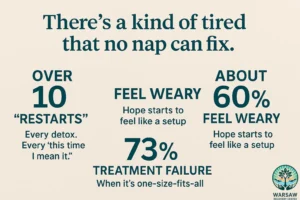
There’s a kind of tired that no nap can fix.
It’s the kind that settles into your bones after years of trying. After every restart. Every detox. Every “this time I mean it.” If you’ve felt that weariness—the kind that builds when hope starts to feel like a setup—you’re not alone. And more importantly, you’re not out of options.
At Warsaw Recovery Center, we understand that recovery isn’t just about stopping heroin use. It’s about building something stable enough that you don’t have to keep starting over. It’s about treatment that actually sticks—and support that actually stays.
The Emotional Weight of “Starting Over”
People talk about relapse like it’s just a step back. But they don’t always talk about what it feels like to try again.
To wake up on the floor—emotionally or literally—and think, “I can’t believe I’m here again.”
To scroll through treatment centers and feel your stomach turn because you’ve been there.
To want to hope, but feel foolish for it.
Restarting hurts not because you’re weak, but because you’re tired. And being tired isn’t failure—it’s a sign you’ve been carrying too much, with too little support that lasts.
Most Treatment Fails When It’s One-Size-Fits-All
Heroin addiction doesn’t follow a script. And neither should recovery.
Too often, people are offered rigid programs that don’t flex with their lives. You might have a job. A child. A mental health diagnosis. A trauma history. And instead of being supported, you’re expected to fit into someone else’s schedule, someone else’s rules, someone else’s “success” path.
When that doesn’t work—when you fall out of the program, or it suddenly ends, or your insurance denies the next step—it’s not you that failed. The system did.
At Warsaw Recovery, we do things differently. We believe the system should work for you, not make you work harder to stay in it.
Medicaid-Friendly Means Less Fear About the Future
Let’s talk honestly: money stress doesn’t disappear when you enter treatment. In fact, it often gets worse. And that fear—that treatment will drain your bank account, or that you’ll be dropped once funding changes—can sabotage healing before it even starts.
That’s why we built our heroin addiction treatment program to work with Medicaid from the beginning. Because in Warsaw, and across Virginia, Medicaid isn’t just helpful—it’s survival for many families.
When you know your treatment is covered, you can actually settle into it. You can breathe a little easier. You can stay.
Consistency Builds Trust—and Trust Builds Recovery
You’ve probably had to tell your story a dozen times to different people. Intake forms. New therapists. Rotating case managers. Each time, reopening the wound just enough to get someone up to speed.
That’s not how it works here.
We believe healing happens in relationship. And relationships need consistency.
At Warsaw Recovery Center:
- You’ll be paired with the same case manager as often as possible
- Groups stay stable, so you’re not always the “new one”
- Our team works together under one roof—so you’re not lost in the shuffle
This kind of consistency doesn’t just feel good. It creates the conditions for real progress.
You Don’t Have to Be “Ready” in Order to Begin
Here’s something that surprises a lot of people: you don’t have to feel excited, inspired, or sure to return to treatment.
In fact, most people who come back to care aren’t feeling anything close to hopeful. They’re numb. Anxious. Doubtful. Exhausted. That’s okay.
You’re allowed to come in burnt out. You’re allowed to show up messy.
You don’t have to believe in yourself yet. Let us believe in you until you can.
A Slower Pace Doesn’t Mean You’re Falling Behind
Some programs push hard: “30 days and you’re out.” “If you miss a session, you start over.” That kind of pressure might work for some. But for others—especially those healing from trauma or deep emotional exhaustion—it can feel like walking on eggshells.
We offer outpatient and IOP (Intensive Outpatient Program) options that allow for breathing room. That means:
- You can take it week by week without losing your spot.
- If life happens, we help you navigate—not punish—you for it.
- Progress is measured in staying connected, not just staying clean.
Because in real recovery, showing up counts.
“They Didn’t Make Me Start Over. They Just Made Space for Me.”
“I thought they’d lecture me. Instead, they just asked how I was doing. It was the first time I felt like a person, not a problem.”
– Returning Client, 2024
Sometimes, the difference between giving up and trying again is how someone greets you when you walk back in.
FAQs: What to Know About Heroin Addiction Treatment in Warsaw, VA
Do I have to stop using heroin before I start treatment?
No. You don’t have to come in “clean” to be accepted. We offer services that meet you where you are—including support for withdrawal, relapse, and ongoing use.
Is heroin addiction treatment really covered by Medicaid in Virginia?
Yes. Warsaw Recovery Center accepts Medicaid, and we work closely with you to handle approvals, paperwork, and reauthorizations. You don’t have to figure it all out alone.
What happens if I miss a few sessions or relapse?
You won’t be kicked out. We’ll reach out, talk through what’s going on, and find a way to stay connected. Recovery isn’t about being perfect—it’s about staying in the conversation.
Can I go to treatment if I have a job or kids?
Yes. Our outpatient and IOP programs are designed with flexibility in mind. We’ll work with your schedule so that you don’t have to choose between care and life responsibilities.
I’ve already been to a bunch of programs. Will this be any different?
We hear this a lot. What makes us different is our commitment to stability: stable coverage, stable staff, stable expectations. We don’t expect perfection—we expect people.
When You’re Ready to Feel Safe Again
Recovery doesn’t require constant reboots. It needs consistent ground.
At Warsaw Recovery Center, we don’t offer quick fixes or miracle language. We offer something quieter—and often more powerful: treatment that shows up for you, even when you can’t fully show up for yourself.
You don’t have to be energized. Or enthusiastic. Or confident. You just have to be willing to let someone hold hope with you for a while.
Ready to stop starting over?
Call (888) 511-9480 or visit our Heroin Addiction Treatment page to learn how Warsaw Recovery Center can help you build something that lasts.