
You’re not falling apart. But you know you’re not okay.
You wake up on time. You answer emails. You make the calls. You pour the wine, or pop the pill, or take the edge off—then you do it all again tomorrow. On the outside, everything looks fine.
Inside? You’re tired. Not the kind of tired that a nap or vacation fixes. The kind that comes from pretending you’re fine while quietly losing touch with who you used to be.
This blog isn’t for people who’ve hit rock bottom. It’s for the ones walking the edge, white-knuckling their way through each day, silently wondering how long they can keep this going.
And we see you. At Warsaw Recovery Center, we help high-functioning people reclaim their clarity—without waiting for a full-blown crisis.
“Functioning” Isn’t the Whole Story
It’s easy to hide behind the optics.
Your bills are paid. You’re doing okay at work. Your partner isn’t asking questions (yet). You haven’t gotten arrested, haven’t lost the house, haven’t “ruined everything.”
But the fact that you’re still functioning doesn’t mean you’re thriving.
It just means you’ve learned how to manage. To ration the chaos. To stay three steps ahead of collapse.
The truth? That kind of “functioning” is a full-time job in itself.
And like any job, it’s going to cost you something. Time. Peace. Sleep. Sanity. Eventually, something cracks.
The Real Cost of High-Functioning Substance Use
Here’s what most people don’t talk about:
High-functioning addiction isn’t easier. It’s quieter—which makes it harder to leave.
You don’t get wake-up calls.
You get warnings no one else sees:
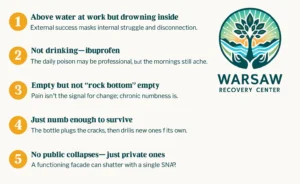
- That creeping anxiety on Monday mornings
- That sense of dread when the bottle’s running low
- That voice that says, “I’m better when I’ve had something—anything.”
And slowly, you build your life around protecting the illusion that everything is fine.
You become the master of looking fine. Of covering the slip. Of counting how much is left and planning your “cutback” attempts in secret.
But when your peace depends on substances that keep needing more to do less—something’s wrong.
That doesn’t make you weak. It makes you human. And it might be time for help.
Detox Doesn’t Mean Disaster. It Means Decision.
We’ve built up this idea that you have to lose everything before you’re allowed to ask for help.
That’s nonsense.
At Warsaw Recovery Center, we work with people who’ve kept up the appearance of “okay” long past their limits. And when they finally walk through our doors, they almost always say the same thing:
“I thought I had to be worse before I was allowed to be here.”
You don’t.
You don’t have to wait until you get fired.
You don’t have to wait until someone confronts you.
You don’t have to wait until you can’t function anymore.
You’re allowed to look at your life and say:
“I don’t want this to be the way I live anymore.”
That’s what substance use detox is about. It’s not punishment. It’s permission—to rest, reset, and rebuild from a place of honesty.
What Detox Actually Looks Like for High-Functioning People
Forget the horror stories. Detox, when done right, doesn’t look like misery or cold-turkey suffering.
Our Substance Use Detox program in Virginia is structured, medically supported, and human. Here’s what you can expect:
- Private, stigma-free environment: No moralizing. No lectures. Just safety and discretion.
- 24/7 medical supervision: We help manage withdrawal symptoms safely—especially for substances like alcohol, benzos, or opioids.
- Therapeutic support: You don’t just detox your body. You start to untangle the emotional knots too.
- Transition planning: Detox isn’t the end—it’s the door. We help you decide what comes next.
For high-functioning folks, that door can be life-changing. Because when you’ve built your identity on holding it all together, finally putting something down can feel like the bravest thing in the world.
When the Lie Starts to Crack
It usually doesn’t start with some dramatic breakdown.
It starts small.
- A forgotten appointment.
- A fight you can’t even remember starting.
- A morning where the shakes feel a little worse.
- A night where you use just a bit more than you meant to.
And then something clicks:
“I’m not in control anymore. And I haven’t been for a while.”
That moment is terrifying. But it’s also sacred. Because it’s the moment you stop gaslighting yourself. You stop pretending that because your world hasn’t collapsed, you’re not allowed to feel scared.
You are.
And we’re here to help you do something with that fear—before it becomes something worse.
You’re Not a Fraud. You’re Just Overdue for Relief.
There’s a flavor of shame that’s unique to high-functioning people.
It sounds like:
- “If I were really addicted, I wouldn’t still be doing well at work.”
- “Maybe I’m just lazy. Or unmotivated.”
- “If I had more willpower, I could cut back.”
Here’s the truth:
You don’t need to be worse to deserve help. You need to be done.
Done pretending. Done managing. Done living like this is the only way.
Substance use detox doesn’t erase you. It reconnects you—to sleep, to clarity, to a nervous system that’s not hijacked by craving or withdrawal.
That reconnection? It changes everything.
You Can Leave the Mask at the Door
We know how exhausting it is to wear the mask.
To look successful. Smart. Capable. Pulled together.
In detox, you don’t have to do that anymore.
You can be quiet. Messy. Vulnerable.
You can cry. Or not.
You can talk. Or rest.
You can fall apart just enough to start again.
We’ll hold the rest with you.
FAQs About Substance Use Detox for High-Functioning People
Do I really need detox if I’m still managing life okay?
Yes. If you’re chemically dependent, “managing” becomes its own prison. Detox helps you stabilize physically and mentally so you can move forward—before it all slips.
How can I keep this private?
We understand discretion is critical. All treatment at Warsaw Recovery Center is confidential. We help many high-functioning individuals who need privacy to protect their work and personal lives.
Is detox dangerous?
Attempting detox at home can be dangerous—especially with alcohol, benzos, or opioids. Our detox program provides 24/7 medical supervision to ensure your safety and comfort.
Will I lose everything if I take time off for detox?
In truth, many people preserve their jobs, relationships, and reputations by stepping away early. A short break now prevents much larger losses later.
What happens after detox?
Detox is just the first step. We help you create a customized next-step plan—whether that’s residential care, outpatient treatment, or a supportive recovery environment.
Ready to drop the mask and choose relief?
Call (888) 511-9480 to learn more about our Substance Use Detox services in Warsaw, Virginia. You don’t have to break down to begin again. Let’s start before it gets that far.