So… you’re young, sober (or thinking about it), and feeling kind of alone in it.
Maybe your friends are still partying. Maybe you’re watching them crash and burn and wondering if you’re next. Maybe you already tried to quit, messed up once or twice, and now you don’t know what to do. Or maybe you’re the quiet one—googling “heroin addiction treatment in Warsaw” from your phone in the middle of the night, hoping no one finds out.
Wherever you’re at, here’s what we want you to know:
You’re not the “weird one” for wanting something different.
You’re just ahead of the curve.
At Warsaw Recovery Center, we see young people take this step every week. And we know what it’s like to wonder if you’re too young, too broke, or too late to get started.
You’re not. Here’s why.
1. You Don’t Have to Be Falling Apart to Get Help
Let’s kill this idea right now: you don’t need to “hit bottom” before you qualify for support.
Maybe you haven’t lost everything. Maybe your life still kind of works—on the surface. You go to school, hold a job, post funny stuff online. But underneath? You’re running on fumes. Numbing out. Chasing a high that doesn’t hit the same anymore.
You don’t have to wait for things to collapse. If something in you says, “I can’t keep living like this,” you’re allowed to act on that now.
2. Medicaid Makes Treatment Possible—Even If You’re Broke
Money is real. And let’s be honest: most of us don’t have savings accounts at 22.
The good news? Medicaid covers heroin addiction treatment here in Virginia—and that includes outpatient programs like the one we offer in Warsaw. You don’t need to drop thousands on a private rehab. You don’t need to hide your bills from your parents or figure it out on your own.
If you’re already enrolled in Medicaid, we’ll help you use it. If you’re not sure if you qualify, we’ll walk you through that too.
3. There Are Other Young People in Recovery—You’re Just Not Seeing Them Yet
Early recovery can feel isolating. Especially if the only people you see in meetings or treatment groups are decades older than you.
But don’t let that fool you. There are a lot of young people quietly figuring this out. They just might not be as loud about it—yet.
At our center, we hear your references. We understand your world. You won’t have to translate your experience to be taken seriously. We know that being young and addicted to heroin is real—and we treat it like it matters.
4. Treatment Doesn’t Mean You’re “Not Fun” Anymore
Let’s get real: if you’re young and social, the idea of getting sober can feel like giving up part of your personality.
Heroin might have helped you feel bold. Or funny. Or just less anxious around people. That’s valid. But also—if you’re reading this, there’s a good chance it’s started to take more than it gives.
Treatment helps you build confidence that doesn’t depend on a high. And yeah—it takes time. But it’s the kind of confidence that lasts, even when your phone is dry and the party’s over.
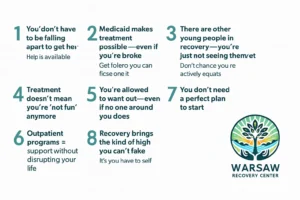
5. You’re Allowed to Want Out—Even If No One Around You Does
Here’s the awkward truth: deciding to stop can make you feel like the odd one out.
Your friends might not get it. They might joke, pressure you, or make you feel like you’re “doing too much.” That can mess with your head—especially when you’re young and still figuring things out.
But choosing peace over chaos isn’t a betrayal. It’s you choosing yourself. You don’t have to convince anyone else it’s the right move. You just have to start.
6. Outpatient Programs = Support Without Disrupting Your Life
Not every treatment option means disappearing for 30 days.
At Warsaw Recovery, we offer outpatient heroin addiction treatment that fits into real life. That means you can:
- Live at home
- Keep your job or school schedule
- Still get group support, therapy, and check-ins
- Get all of this covered through Medicaid
This isn’t a watered-down version of treatment. It’s care that respects your autonomy.
7. You Don’t Need a Perfect Plan to Start
You don’t need to have your whole life mapped out.
You don’t need to know how to tell your friends. Or if you’ll be sober forever. Or what your five-year goal is.
You just need to call. Or text. Or show up and say, “I think I need help.”
That’s it. That’s the plan.
8. Recovery Brings the Kind of High You Can’t Fake
You might not believe this yet—but there’s something wild that happens in real recovery.
You start remembering things. Noticing the sky. Laughing and meaning it. You stop waking up in panic, wondering what you said or where you left your stuff. You show up for things. For people. For yourself.
It’s not boring. It’s freeing. It’s weird at first—but in the best way.
What’s Treatment Like for Young People at Warsaw Recovery?
At our center, we make space for:
- Young adults figuring out their first steps into recovery
- Clients who feel awkward, unsure, or overwhelmed
- Medicaid users who need help navigating coverage
- People who’ve relapsed, ghosted treatment before, or never tried it
We offer IOP (Intensive Outpatient Program), individual therapy, and recovery support that fits into your schedule and your life. And we take you seriously—whether this is your first attempt at recovery or your fifth.
You’re not too much. You’re not too far gone. You’re not too young.
FAQs: Heroin Addiction Treatment for Young Adults in Virginia
Is heroin addiction treatment really covered by Medicaid?
Yes. If you’re eligible for Medicaid in Virginia, it can cover outpatient services, IOP, counseling, and more. Our team at Warsaw Recovery can help you apply or check your status.
Do I have to go to inpatient rehab first?
Nope. You can start with outpatient treatment, especially if you have support at home or need flexibility for work or school. We’ll help you figure out what level of care makes sense for you.
What if I’m still using? Can I still come in?
Absolutely. You don’t have to be clean to start treatment. We’ll meet you where you are and work with you from there. No judgment.
I’m not ready to quit forever. Should I still reach out?
Yes. You don’t have to commit to forever to ask for help. Even if you’re unsure, even if you just want to learn more—your questions are valid.
What if I tried treatment before and it didn’t work?
That’s okay. Trying again doesn’t mean you failed. It means you’re still here—and that matters. Our program might offer something different that fits better this time.
You Don’t Have to Feel “Ready.” You Just Have to Reach Out.
If you’re young and wondering whether you belong in treatment, here’s your answer:
You do.
You don’t need a rock bottom moment. You don’t need a plan. You don’t need to be perfect. You just need a place that gets how weird, hard, and beautiful early recovery can be.
Warsaw Recovery Center is that place. And you’re already closer than you think.
Ready to start, even if it feels a little weird?
Call (888) 511-9480 or visit our Heroin Addiction Treatment page to learn more about Medicaid-friendly options for young adults in Warsaw, Virginia.
We’re not here to fix you. We’re here to welcome you.