Sometimes the hardest question isn’t “Do I need help?”—it’s “What kind of help do I need?”
If you’re sober curious but feeling worn out, stuck, or unsure what will actually make a difference, the decision between outpatient, intensive outpatient (IOP), and a residential treatment program can feel overwhelming.
The truth is, there’s no shame in not knowing right away. For some people, outpatient care works beautifully. For others, it’s like trying to heal in the middle of a storm—you just can’t get enough space to truly recover.
The Core Difference: Living There vs. Going Home
Residential treatment means you live at the facility for the duration of care. It’s an immersive environment where your days are fully structured around healing—therapy, skill-building, rest, and support—without outside distractions.
Outpatient and IOP, on the other hand, let you return home after sessions. This can be ideal if you have a strong, supportive environment and the ability to stay accountable on your own.
Think of it like physical rehab: if you have a minor injury, outpatient sessions might be enough. But if the injury keeps getting aggravated, sometimes you need to be in a dedicated space where recovery is the only priority.
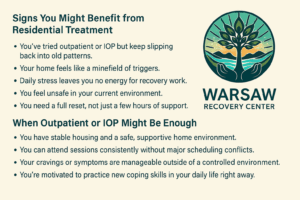
Signs You Might Benefit from Residential Treatment
You may want to consider residential care if:
- You’ve tried outpatient or IOP but keep slipping back into old patterns.
Repeating the same approach without progress can drain hope. A new environment can help you break the cycle. - Your home feels like a minefield of triggers.
This might be people, places, or routines that make it hard to stay on track. - Daily stress leaves you no energy for recovery work.
If you’re constantly managing crises or responsibilities, you may not have the bandwidth to do deep healing work at home. - You feel unsafe in your current environment.
Emotional or physical safety is the foundation of recovery. Without it, other treatment efforts may falter. - You need a full reset, not just a few hours of support.
Sometimes you need to step away completely to rebuild.
When Outpatient or IOP Might Be Enough
Residential care isn’t always necessary. You might find that outpatient or IOP works well if:
- You have stable housing and a safe, supportive home environment.
- You can attend sessions consistently without major scheduling conflicts.
- Your cravings or symptoms are manageable outside of a controlled environment.
- You’re motivated to practice new coping skills in your daily life right away.
These options can be more flexible and cost-effective, making them a good first step for many people.
A Story of Finding the Right Fit
One client came to us after two rounds of outpatient treatment. She was motivated and determined, but every time she returned home, the same pressures and people were waiting. She told us, “It felt like trying to swim upstream in a river that only got faster.”
When she entered residential care, she finally had the quiet and safety to focus on herself. The structured schedule and constant support made it easier to stick with the hard parts of healing.
Months later, she said, “Living there gave me my life back. I finally had a fighting chance.”
Her story is not unusual. Sometimes it’s not about you failing treatment—it’s about the treatment setting not matching what you truly need.
It’s Not About Failing—It’s About Matching the Care to Your Needs
Many people think stepping into residential care means they’ve “failed” at less intensive options. That’s simply not true.
Recovery is about finding the right fit, not proving you can get well under the toughest circumstances. Choosing residential care is like choosing a cast for a broken bone instead of a bandage—it gives your mind and body the time, space, and structure to heal fully.
How Residential Treatment Creates Change
Here’s what makes residential treatment in in Virginia different in a way that can shift the odds in your favor:
- 24/7 Support: Staff are available at all times, so moments of crisis or doubt are met with immediate help.
- Structured Schedule: Days are planned with therapy, activities, and rest in mind, which creates a sense of stability.
- Separation from Triggers: By removing yourself from your regular environment, you give your brain and body a chance to reset.
- Peer Connection: You live alongside others who understand what you’re going through, which can be deeply validating.
- Integrated Care: Medical, emotional, and practical support are often under one roof, reducing the gaps in care.
Hope Is in the Options
Whether you begin in residential care or step into it after trying outpatient, the important thing is this: you have choices.
Recovery is rarely a straight line. It’s more like climbing a mountain—sometimes you take a different path, sometimes you stop and rest, and sometimes you need a guide to walk with you the whole way.
You are not out of options. You are not out of chances. The right environment can make all the difference in whether change feels possible and sustainable.
Call (888) 511-9480 or visit our residential treatment program services in Warsaw, Virginia to learn more about how we can help you find your footing and move forward.
FAQs About Choosing a Residential Treatment Program
How long does residential treatment usually last?
Programs vary, but many last between 30 and 90 days. Some offer extended care for those who need more time.
Can I work while in residential treatment?
Most residential programs are full-time commitments, so outside work is usually paused. This break is intentional—it gives you the space to focus fully on recovery.
Is residential treatment more effective than outpatient?
It depends on your needs. For those with severe symptoms, unsafe environments, or repeated relapse, residential care often has higher success rates.
Will insurance cover residential treatment?
Many insurance plans cover some or all of residential care. It’s best to contact the program’s admissions team to confirm coverage and discuss payment options.
What happens after residential treatment?
Most people step down to outpatient or IOP after residential care. This helps you transition back into daily life while still receiving support.