
Learning that a parent, grandparent, or another close relative struggled with alcohol can bring up difficult questions.
You may wonder whether you’re destined to develop the same problem—or whether every drink puts you on the same path.
If you’ve been searching “is alcoholism genetic,” you’re not alone. It’s one of the most common questions people ask after discovering a family history of alcohol use disorder.
The reassuring answer is this:
Genetics can increase your risk, but they do not determine your future.
Researchers have found that alcohol use disorder has a significant genetic component. At the same time, genes are only one part of a much larger picture that includes life experiences, mental health, relationships, stress, and personal choices.
If you’re concerned about your own drinking or a family history of alcohol problems, learning more about alcohol addiction treatment can help you understand your options. At Warsaw Recovery Center, we support individuals throughout Fredericksburg, Williamsburg, and surrounding Virginia communities with compassionate, evidence-based care.
Knowing you may have an increased risk isn’t a reason to lose hope. It’s an opportunity to make informed decisions and seek support early if you need it.
Is Alcoholism Inherited?
Yes—but only in part.
Research consistently shows that alcohol use disorder tends to run in families.
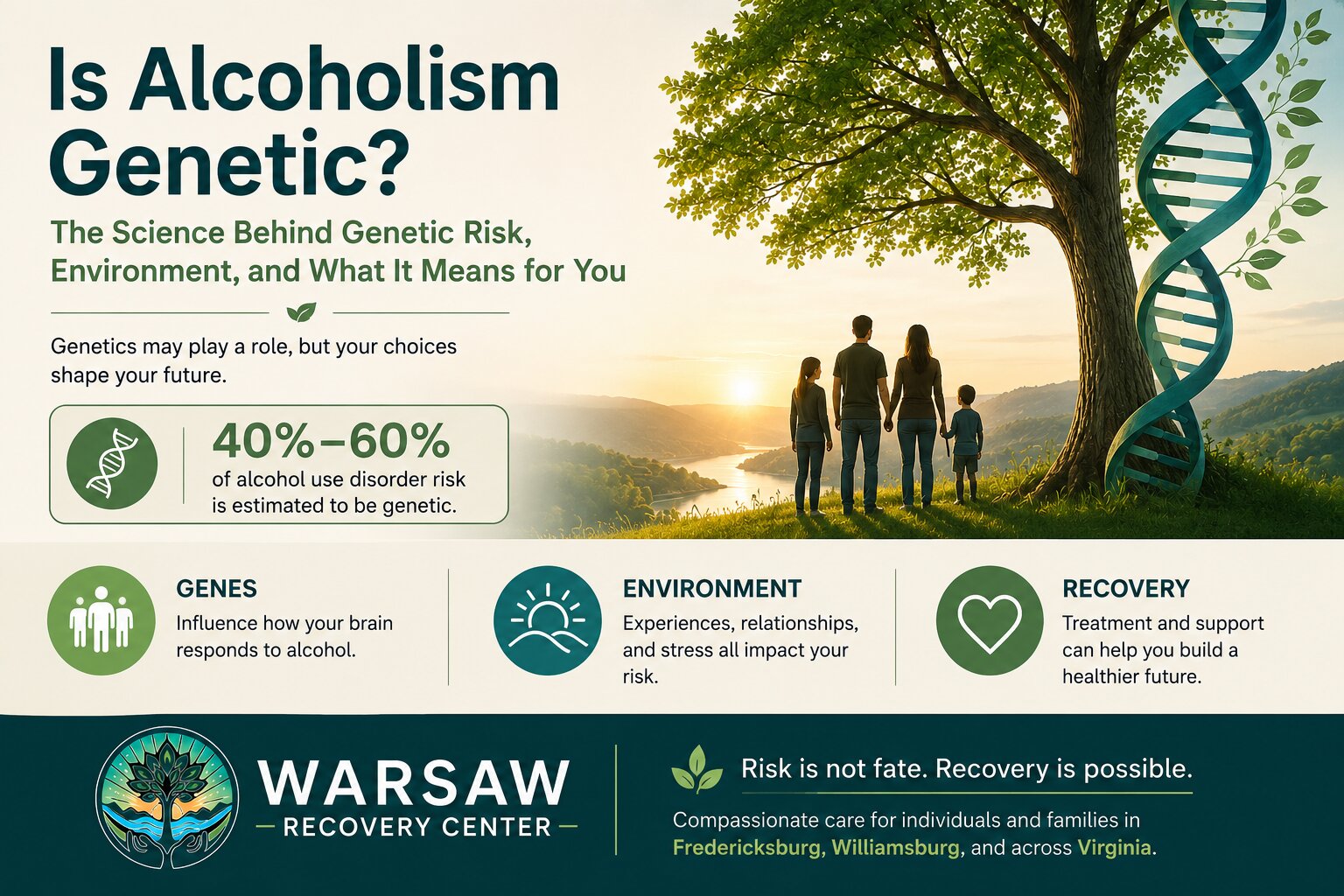
Scientists estimate that genetics account for roughly 40% to 60% of a person’s risk of developing alcohol use disorder.
That means inherited biological factors influence vulnerability, but they do not fully explain why someone develops a drinking problem.
Unlike conditions caused by a single gene, alcohol use disorder involves many different genes that each contribute a small amount to overall risk.
Some inherited traits may influence:
- How rewarding alcohol feels
- How quickly the body processes alcohol
- Impulsivity
- Stress responses
- Risk-taking tendencies
- Sensitivity to cravings
These biological differences help explain why two people can drink similar amounts while having very different long-term outcomes.
Genes vs. Environment
Genetics are only one part of the story.
Environment plays an equally important role.
Even someone with a strong family history may never develop alcohol use disorder.
Likewise, someone with no known family history can still experience addiction.
Environmental influences include:
Childhood experiences
Growing up around heavy drinking can shape attitudes about alcohol and what feels “normal.”
Experiences such as trauma, neglect, or chronic stress may also increase vulnerability.
Mental health
Conditions like:
- Anxiety
- Depression
- PTSD
- Bipolar disorder
can increase the likelihood that someone uses alcohol to cope with emotional distress.
Peer and social influences
Friends, workplace culture, college environments, and community norms all affect drinking behaviors.
Stress and coping skills
People who lack healthy ways to manage stress may be more likely to rely on alcohol for temporary relief.
Genes may influence susceptibility, but environment often determines whether that vulnerability is expressed.
What Genetic Risk Actually Means for You
One of the biggest misconceptions is that inherited risk guarantees addiction.
It doesn’t.
Think of genetic risk like having a higher likelihood of developing high blood pressure or diabetes.
It increases the chances—but it doesn’t guarantee the outcome.
If alcohol use disorder runs in your family, it may mean:
- Your brain responds differently to alcohol.
- You may develop dependence more easily than someone without that family history.
- Heavy drinking could become problematic more quickly.
- Paying attention to your drinking habits may be especially important.
It does not mean that addiction is inevitable.
Risk is not the same as certainty.
Family History Is Information—Not a Prediction
Discovering a family history of alcohol misuse can feel frightening.
Some people begin wondering whether every decision they make has already been determined.
Fortunately, that’s not how genetics work.
Knowing your family history gives you useful information.
It allows you to:
- Make informed choices about drinking
- Recognize warning signs earlier
- Seek help sooner if concerns develop
- Build healthy coping skills
- Have honest conversations with healthcare professionals
Awareness can become a protective factor rather than a source of fear.
Having the Gene Does Not Determine Your Story
Even if you inherit multiple risk factors, your future remains influenced by countless decisions and circumstances.
Many people with a strong family history never develop alcohol use disorder.
Others recognize unhealthy patterns early and make changes before dependence develops.
Recovery is also possible for people whose genetics contributed to addiction.
The brain retains the ability to heal and adapt throughout life.
Evidence-based treatment helps people:
- Understand triggers
- Develop healthier coping strategies
- Address co-occurring mental health conditions
- Build supportive relationships
- Reduce relapse risk
- Create long-term recovery plans
Genetics may influence where the journey begins.
They do not determine where it ends.
Signs It May Be Time to Take a Closer Look
Whether or not alcohol use disorder runs in your family, it’s worth paying attention if you notice that you:
- Drink more than you intended
- Have difficulty cutting back
- Need increasing amounts of alcohol to feel the same effects
- Continue drinking despite relationship or work problems
- Experience cravings
- Feel anxious or unwell when you don’t drink
- Spend significant time thinking about alcohol
These experiences don’t automatically confirm alcohol use disorder.
However, they are good reasons to seek a professional evaluation.
Early support is often more effective than waiting until problems become severe.
Can You Reduce Your Risk?
Yes.
While you can’t change your genetics, you can influence many of the other factors that affect alcohol use.
Helpful strategies include:
- Being aware of your family history
- Setting personal limits around alcohol
- Developing healthy ways to manage stress
- Seeking treatment for anxiety, depression, or trauma
- Building supportive relationships
- Talking openly with your healthcare provider if you’re concerned
Small decisions made consistently over time can significantly influence long-term outcomes.
Getting Help for Alcohol Addiction in Virginia
If alcohol use is becoming harder to control—or if you’re worried because of your family history—you don’t have to figure it out alone.
Many people seek help long before alcohol causes severe consequences.
That early step can make treatment more effective and recovery more sustainable.
At Warsaw Recovery Center, we provide compassionate, individualized treatment for alcohol use disorders throughout Fredericksburg, Williamsburg, and communities across Virginia.
Whether you’re concerned about your own drinking, your family’s history, or recurring patterns that feel difficult to change, our team can help you better understand your situation and explore evidence-based treatment options.
Your genetics may influence your starting point.
They do not define your future.
Frequently Asked Questions
Is alcoholism inherited?
Research shows that alcohol use disorder has a significant inherited component, with genetics accounting for approximately 40% to 60% of overall risk. However, environmental factors and personal experiences also play major roles.
If a parent is an alcoholic, will I be?
No. Having a parent with alcohol use disorder increases your risk, but many people with a family history never develop alcohol addiction. Genetics increase susceptibility—they do not determine your future.
Does genetics mean I cannot recover?
Absolutely not. Genetics do not prevent recovery. Evidence-based treatment, healthy coping strategies, supportive relationships, and ongoing care help people recover from alcohol use disorder regardless of family history.