
When you’re the parent of a young adult who just went through detox—again—it’s hard not to feel like you’re holding your breath. You watched them suffer through withdrawal, you held the hope together when they couldn’t. And now? They’re out. And they’re using again.
You may be asking, “What was the point of all that? Doesn’t the detox program make them stay sober? Shouldn’t there be some rule—some way to make them keep going?”
If you’re asking these questions, it means you still care. It means you still believe this isn’t who your child really is. And you’re right. But it also means you’re tired—and you deserve real answers, not blame or false promises.
Let’s break this down gently, but honestly.
Can a detox program legally require sobriety afterward?
No. Detox programs—whether Medicaid-funded or private—cannot legally force a person to stay sober after discharge. Once the medical withdrawal phase is complete and the individual is no longer at risk of physical harm from withdrawal, they are considered stable enough to leave, regardless of what they choose to do next.
Unless they are under a court order, guardianship, or specific legal arrangement, they have the legal right to walk away.
That might feel devastating, especially when you’ve done everything you can to help them. But it’s also the legal and ethical reality of how substance use treatment works in the United States. Even if Medicaid is paying for the treatment, it doesn’t come with strings to control their choices after.
You are not crazy for wanting there to be more accountability. And no, you’re not overreacting. You’re just up against the limits of a system that was never built with parental grief in mind.
What is detox actually responsible for?
Detox is about stabilization. Period. It’s the first step in a continuum of care that ideally leads to longer-term treatment, therapy, support groups, and new coping tools.
Here’s what a Medicaid alcohol detox program does provide:
- 24/7 medical monitoring for withdrawal symptoms
- Medication (when appropriate) to manage alcohol withdrawal safely
- Initial assessments to evaluate mental health and addiction severity
- Short-term stabilization, usually 3–7 days
- Discharge planning, including referrals to further treatment
Here’s what detox doesn’t do:
- Guarantee long-term sobriety
- Force someone to attend therapy after discharge
- Change the behaviors, trauma, or environment that led them to drink in the first place
It’s a start. A necessary one. But it’s not a cure.
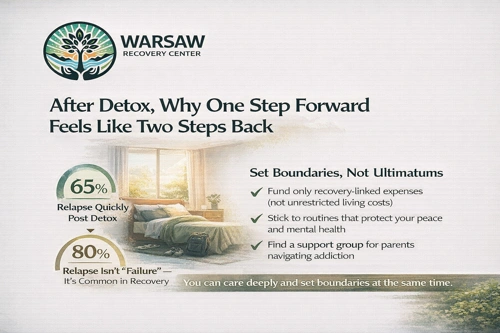
Why does relapse feel so common after detox?
Because it is. Especially when detox is the only level of care someone receives. Alcohol addiction isn’t just about the substance. It’s about the pain, the patterns, the mental health struggles underneath. And detox alone doesn’t touch those.
In fact, many people relapse within days or weeks of detox if they don’t continue care. That’s not because they’re weak or ungrateful—it’s because they’re still sick. Detox clears the body. It doesn’t rebuild the life.
Think of it like this: Detox is like stopping a runaway car. Helpful? Absolutely. But if you don’t fix the engine or learn how to steer, the moment you restart it, you’re likely to crash again.
What happens after Medicaid detox?
Medicaid programs in Virginia generally require that providers offer discharge planning and referrals for continuing care. That may include:
- Residential treatment (if medically necessary)
- Partial Hospitalization Programs (PHP)
- Intensive Outpatient Programs (IOP)
- Sober living referrals
- Therapy or case management services
- Peer recovery support specialists
But none of these are guaranteed unless the person agrees to participate. And that’s the part that breaks so many parents’ hearts.
Your child can have a full list of next steps in their hand—and still walk away from it all.
What you can do is stay informed. Learn what options exist. Get to know places like Warsaw Recovery Center’s alcohol detox program in Virginia, where the care doesn’t end when the detox does. We build treatment plans designed to continue care seamlessly for those who are ready.
Can I, as a parent, make them go to treatment after detox?
No—not if they’re legally an adult and not under court supervision. This is the hardest reality for most parents of young adults: you can no longer make them do what’s best for them, even when it’s clear they need help.
That doesn’t mean you have no role to play. Far from it.
Here’s what you can do:
- Set boundaries around what support you’re willing to offer
- Express clearly (without threat) that you’ll only help fund things tied to recovery
- Get support for yourself to avoid enabling behaviors
- Stay in loving communication without rescuing or bargaining
- Reframe your role from rescuer to witness and advocate
Your influence is still powerful—it just looks different now. It’s no longer about pulling them out of the water. It’s about making sure you don’t drown with them, and being visible from shore if they ever reach out again.
What support exists for me as a parent?
This isn’t just about them. This is about you. And if no one has said it to you yet: You deserve support too. Watching your child suffer through addiction and relapse can traumatize you. It can break down your nervous system, strain your marriage, isolate you from friends, and drain your finances.
That’s not overdramatic. That’s grief in real time.
Some places to start reclaiming your own oxygen mask:
- Family therapy at a treatment center or independent provider
- Al-Anon meetings (for families and loved ones of people with alcohol addiction)
- Peer support groups specifically for parents
- Therapists who specialize in addiction-adjacent family systems
At Warsaw Recovery Center, we encourage families to be part of the healing—not as enforcers, but as humans who matter too.
Should we bother with detox again if they already relapsed?
If they’re willing—even slightly—yes. Because no two attempts at recovery are the same. And every time someone goes through detox, there’s a chance they’ll say yes to the next level of care. Or connect with a staff member who actually gets through to them. Or have just enough clarity to recognize, “I want something different.”
Yes, it’s frustrating. Yes, it’s expensive. Yes, it can feel hopeless.
But there are people who went to detox five times—and only got sober after the fifth. There are parents who thought this would be the one… and it wasn’t. Until one day, it was.
Detox isn’t a waste. It’s another swing of the bat. And your child deserves another swing. Not because you owe it to them—but because addiction isn’t a game of first tries. It’s a war of attrition. And sometimes the person who wins is the one who simply didn’t stop trying.
What does “success” look like after detox?
Not a straight line. Not instant gratitude. Not a perfect behavior shift.
Realistic signs of forward movement might include:
- Willingness to talk to a therapist
- Accepting help from a recovery coach or peer
- Exploring next steps in IOP or residential care
- Recognizing triggers and saying so
- Staying sober for hours or days longer than before
It might be messy. It might include another relapse. But if there’s even some movement, that’s not failure—it’s friction. And friction means contact. Contact means possibility.
Hope Doesn’t Mean Denial
Let’s be clear: Hope isn’t pretending everything’s fine. Hope is showing up with open eyes, broken heart, and a stubborn belief that something could still change.
Even if it didn’t work last time.
Even if they don’t call you back.
Even if you’re scared to hope again.
You can hold hope and boundaries at the same time. You can love them without enabling. You can want healing while protecting your own peace.
If you’re searching for alcohol detox support in Warsaw, Virginia—somewhere that sees the whole family, not just the individual—learn more about our alcohol detox program services. We’re here to walk with you, one step at a time.
Call (888) 511-9480 to learn more about our alcohol detox program services in Warsaw, Virginia.