
Every morning starts with certainty.
Today will be different.
You’ll get through work, drive home, eat dinner, maybe watch a show, and go to bed without stopping for alcohol.
You genuinely mean it.
Then the workday ends.
Your shoulders feel tight. Your mind is exhausted. The stress you’ve been carrying all day finally catches up with you. Somewhere between leaving the office and pulling into your driveway, the plan changes.
Again.
By the time you’re standing at the liquor store counter, frustration has already started creeping in.
“Why am I doing this?”
“If I wanted to stop this morning, why can’t I stop now?”
“Why does this keep happening?”
At Warsaw Recovery Center, we’ve spoken with many people who eventually began exploring alcohol addiction treatment in Virginia after asking themselves these exact questions.
The answer is rarely as simple as a lack of willpower.
In fact, many of the people struggling most are trying harder than anyone realizes.
Morning Decisions and Evening Decisions Come From Different Places
One of the most confusing things about alcohol use is how sincere your intentions can feel.
You aren’t lying to yourself in the morning.
You truly want things to be different.
You remember the poor sleep.
The anxiety.
The promises you made.
The money spent.
The lingering regret.
Morning gives you distance from alcohol, and that distance often creates clarity.
But evening arrives with a completely different set of circumstances.
You’re tired.
Your stress level is higher.
Your emotional defenses are lower.
And your brain remembers something important:
Alcohol has provided relief before.
That doesn’t mean it solved anything.
But it created temporary relief.
The brain pays attention to relief.
Especially after a difficult day.
So when evening arrives, you’re no longer making decisions under the same conditions you were in at 8 a.m.
That’s one reason the cycle can feel so confusing.
Why the Drive Home Can Feel Like a Trigger
Many people believe they make a conscious decision to drink every evening.
Sometimes that’s true.
Often, the process begins much earlier.
Think about how many routines happen automatically throughout your day.
You brush your teeth without thinking about every movement.
You drive familiar roads without actively analyzing every turn.
Habits become automatic because the brain is designed to conserve energy.
Alcohol-related routines can work the same way.
The end of the workday becomes associated with drinking.
Certain roads become associated with drinking.
Certain feelings become associated with drinking.
Eventually, the routine starts running in the background.
Work ends.
Stress appears.
The car heads toward home.
The urge shows up.
The stop becomes automatic.
Many people tell us:
“It feels like I was halfway there before I even realized what I was doing.”
That’s not because they don’t care.
It’s because habits can become deeply ingrained.
Stress Relief and Emotional Escape Are Different Things
When people talk about drinking after work, they often describe it as stress relief.
Sometimes that’s true.
But many people discover they’re seeking something deeper.
Not relaxation.
Escape.
Escape from pressure.
Escape from loneliness.
Escape from disappointment.
Escape from racing thoughts.
Escape from feeling emotionally exhausted.
Alcohol can temporarily soften difficult emotions.
For a few hours, everything feels quieter.
But eventually the effect wears off.
The stress returns.
The anxiety returns.
The responsibilities return.
And now there’s often guilt layered on top.
It’s a little like putting a bucket under a leaking roof.
The bucket helps temporarily.
But the leak is still there.
Over time, the problem grows larger.
The Hidden Cost of Fighting Yourself Every Day
People often focus on the physical effects of drinking.
Those matter.
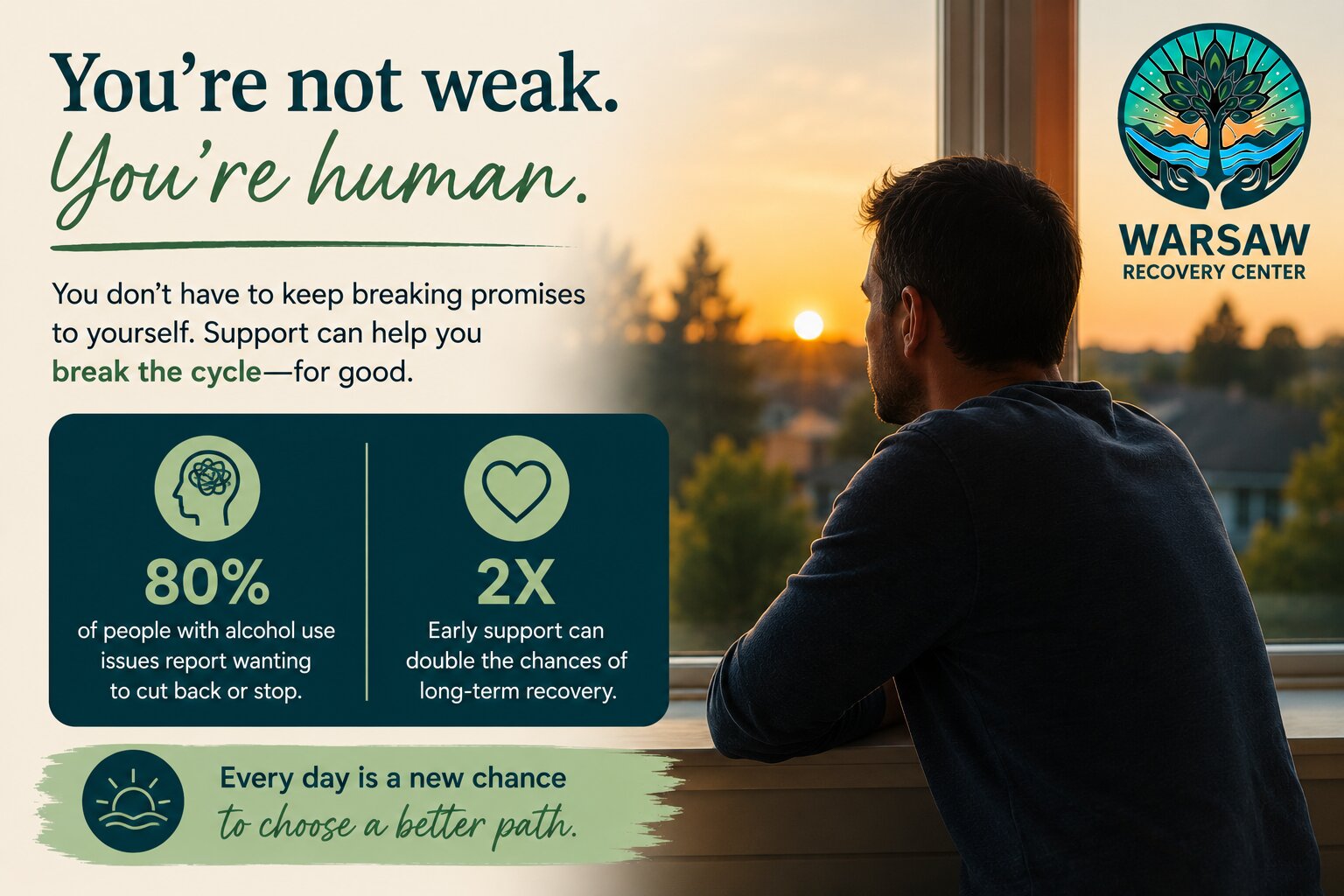
But many overlook the emotional toll of constantly breaking promises to yourself.
At first, it feels frustrating.
Then it starts affecting confidence.
You begin questioning your own judgment.
You stop trusting yourself.
You become hesitant to make commitments because you’re unsure whether you’ll follow through.
We’ve heard people say things like:
“I don’t even believe myself anymore.”
That statement carries a lot of pain.
Because it isn’t really about alcohol.
It’s about self-trust.
Every morning becomes another attempt.
Every evening becomes another disappointment.
Eventually, some people become so discouraged that they stop making promises altogether.
Not because they don’t want change.
Because they don’t want another letdown.
Why Smart, Successful People Get Stuck Here Too
One of the biggest misconceptions about alcohol problems is that they only affect people whose lives are falling apart.
That’s simply not true.
Many individuals struggling with alcohol are highly responsible.
They work full-time.
They raise families.
They manage businesses.
They pay bills.
They show up for others.
From the outside, everything appears fine.
That appearance often becomes part of the problem.
Because they continue functioning, they convince themselves they shouldn’t need help.
They tell themselves:
“I still have a job.”
“I haven’t lost everything.”
“I should be able to handle this.”
The problem is that functioning and thriving are not the same thing.
Many people who appear successful are carrying enormous emotional exhaustion behind closed doors.
The question isn’t whether you’re still functioning.
The question is whether alcohol has become something you feel unable to control.
For many people searching online because they feel they can’t stop drinking, that’s the realization that finally pushes them to seek answers.
Waiting for a Bigger Problem Usually Creates One
A common belief is that things need to become worse before help makes sense.
People often tell themselves they’ll reach out after one more incident.
One more argument.
One more embarrassing moment.
One more failed attempt.
The challenge is that alcohol problems rarely improve through delay.
They often become more deeply woven into daily life.
What starts as drinking after difficult days can expand into drinking after good days.
Then weekends.
Then social events.
Then ordinary evenings.
Eventually alcohol becomes the answer to every emotional question.
That’s why early action matters.
Not because you’re failing.
Because prevention is easier than repair.
Recovery Starts Earlier Than Most People Think
Many people imagine recovery begins the day someone quits drinking.
In reality, it often starts much earlier.
It begins when someone becomes curious.
When they start asking questions.
When they wonder whether life could feel different.
When they stop assuming they have to solve everything alone.
Some individuals begin looking for care in Fredericksburg.
Others explore support and care in Williamsburg.
The specific location matters less than the willingness to reach out.
Because recovery doesn’t begin with certainty.
It begins with openness.
An openness to learning.
An openness to support.
An openness to believing that change is possible.
The Question Underneath Every Search
Most people don’t search for information about alcohol because they’re curious.
They’re searching because something hurts.
Because they’re tired.
Because they’re worried.
Because they’re exhausted from repeating the same cycle.
The question underneath all those searches is usually the same:
“Can this actually get better?”
The answer is yes.
Not overnight.
Not without effort.
But yes.
We’ve seen people who spent years making promises they couldn’t keep build lives they once believed were impossible.
We’ve seen people who felt trapped regain confidence.
We’ve seen people who thought they had run out of options discover they were just getting started.
The fact that you’re asking questions may be more significant than you realize.
Questions often come before change.
Frequently Asked Questions
Why do I only want alcohol after work?
Many people associate alcohol with relaxation, stress relief, or transitioning out of work mode. Over time, the brain can begin linking the end of the workday with drinking, creating strong habits and cravings.
Why can I stop during the day but not at night?
During the day, you’re often focused, busy, and operating with more mental energy. By evening, stress, fatigue, emotional triggers, and established routines can make resisting alcohol much more difficult.
Does this mean I’m addicted to alcohol?
Not necessarily. However, if you’re repeatedly drinking despite wanting to stop, feeling unable to control your use, or experiencing negative consequences, it’s worth speaking with a professional about your concerns.
Why do I keep breaking promises to myself?
This isn’t usually about weakness or lack of character. Alcohol can affect decision-making, reward pathways, habits, and emotional coping patterns in ways that make behavior difficult to change through willpower alone.
Can treatment help even if my life still looks normal?
Yes. Many people seek help while maintaining jobs, relationships, and responsibilities. You don’t need to wait until everything falls apart before exploring support.
What if I’ve tried to stop before?
Previous attempts don’t predict future outcomes. Many people who eventually achieve lasting recovery have experienced multiple unsuccessful attempts before finding an approach that worked for them.
What should I do if I’m worried about my drinking?
Start by talking with a qualified professional who can help you understand your situation and explore potential options. Seeking information is not a commitment—it’s simply a step toward clarity.
You Don’t Have to Keep Fighting the Same Battle Every Evening
If you’re tired of waking up with determination and ending the day disappointed, you’re not alone.
Many people have stood exactly where you are right now.
The good news is that repeating the same cycle isn’t your only option.
Call (888) 511-9480 or visit our substance abuse treatment Virginia and alcohol addiction treatment Virginia services to learn more about our substance abuse treatment Virginia and alcohol addiction treatment services Fredericksburg, VA.