Let’s talk about the quiet parts of recovery. The weird in-between stage. The “I’m sober, but why do I still feel like a mess?” phase. You’re not drinking. You’re not using. Maybe you even made it through a program. But now what?
You look around and everyone seems to expect you to be thriving. Grateful. “Fixed.” And you’re just… not.
What if you’re still anxious? Still flat? Still wondering if the version of you that showed up to recovery is all there is? It’s lonely—and confusing. And it’s why we need to say this, loud and clear:
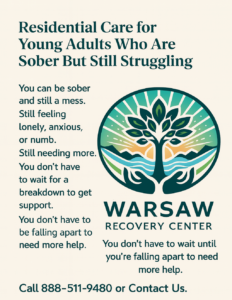
You don’t have to be falling apart to get more help. You don’t need a crisis to qualify for care.
1. Crisis Isn’t the Only Reason to Get Support
The biggest myth in the recovery world? That you only go to residential treatment when you’re at rock bottom. That unless things are actively burning down, you don’t “deserve” to take up space in a program.
But here’s the truth: treatment is about capacity, not catastrophe.
If your mind feels like a crowded, chaotic apartment with no space to breathe, that’s enough. You don’t need a relapse, an overdose, or a breakdown to justify support. You just need a reason. And you are reason enough.
At Warsaw Recovery Center, we believe in care that meets you before the bottom drops out.
2. Residential Treatment Isn’t Punishment—It’s a Reset
Forget what you think you know. Residential treatment isn’t some cold, clinical timeout. It’s not just for detox. It’s not about “fixing” you. It’s about giving you space. Structure. Safety. A reset.
You get to step away from the pressure to perform, the expectations to be okay, the noise that tells you you’re supposed to have this all figured out.
Residential treatment is where you go when you want something deeper than survival. When you’re tired of the gray zone and ready to feel human again.
3. You Can Be Sober and Still Struggling—and That’s Normal
People don’t talk about this enough: sobriety doesn’t fix everything. It gives you the chance to heal. But it doesn’t do the healing for you.
If you’re sober and still feeling numb, anxious, lonely, or like you’ve lost your spark—that doesn’t mean you’re broken. It means there’s more to uncover. And a residential treatment program in Virginia can help you do that without shame.
This isn’t failure. It’s unfinished work. And it’s completely okay to need help finishing it.
4. You Don’t Have to Be the “Worst Off” to Belong Here
Maybe you feel like you’d be taking a bed from someone “who really needs it.” Maybe you think you’re not sick enough, broken enough, addicted enough. But this idea of being “bad enough” is a lie.
Pain doesn’t have to be measured in disasters to count.
At Warsaw Recovery Center, we care less about how dramatic your story sounds—and more about how real your need is. If you’re exhausted from holding it together, if you’re ready for care that goes deeper, you belong here. Period.
5. You Deserve a Community That Gets the In-Between
You’re not out partying anymore. But you’re also not fully settled into a life that feels emotionally satisfying. You feel caught in the middle—sober, but not free. And it’s weird.
Here’s the good news: you are not the only one in that space. In residential treatment, you’ll meet others just like you—people who’ve done the “sobriety thing” but still feel lost. People who are figuring it out without pretending they’re fine.
Connection is healing. And the community you’ll find here might be the most honest one you’ve ever experienced.
6. Getting More Help Isn’t Weak—It’s Smart
There’s this pressure to prove you can do it on your own. To white-knuckle through the discomfort and come out the other side with a smile. But what if you didn’t have to?
Choosing to step into residential treatment isn’t giving up. It’s being honest about what you need—and bold enough to ask for it.
It’s not a step back. It’s a step in.
And trust us—people who do the deeper work early often save themselves years of quiet struggle. You don’t need to wait until you’re hanging by a thread.
7. You Deserve to Feel Fully Alive—Not Just Not Using
This one’s important. Recovery isn’t just about avoiding a drink or a drug. It’s about living.
And if you’re not living—if you’re just kind of existing, emotionally dissociated, or stuck in your own head—you don’t have to stay there.
Residential care offers more than abstinence. It offers reconnection—to your body, your voice, your creativity, your people. It helps you reclaim the version of you that’s been buried underneath coping for too long.
You’re allowed to want joy—not just stability.
Frequently Asked Questions: What Young Adults Ask About Residential Treatment
Can I go to residential treatment even if I’m already sober?
Absolutely. Many people seek residential care after getting sober because they realize there’s deeper emotional or mental health work to do. You don’t have to be in active use to benefit.
What does a typical day look like in residential treatment?
You’ll have a daily schedule that includes therapy (individual and group), time for rest and reflection, structured activities, and connection with others in the program. It’s a mix of calm, challenge, and support.
Is this like rehab? Or more like a retreat?
It’s more structured than a retreat and more supportive than stereotypical “rehab.” At Warsaw Recovery Center, we combine clinical care with emotional depth in a residential setting designed to help you reset—not just stop.
Will I have to talk about my past all day?
Nope. While therapy often involves reflection, you won’t be forced to disclose more than you’re ready for. This is about healing at a pace that works for you.
What if I don’t feel “bad enough” to go?
That thought is common—and it’s usually rooted in stigma. If you’re struggling, if you’re tired, if you want more—then this might be the right step. You don’t have to wait for a disaster to deserve care.
Still Feeling Like the “Weird One”? We See You.
Call (888) 511-9480 or Contact Us to learn more about how we help young adults who are already sober—but not done healing. No breakdown required. Just a little honesty and a next step.