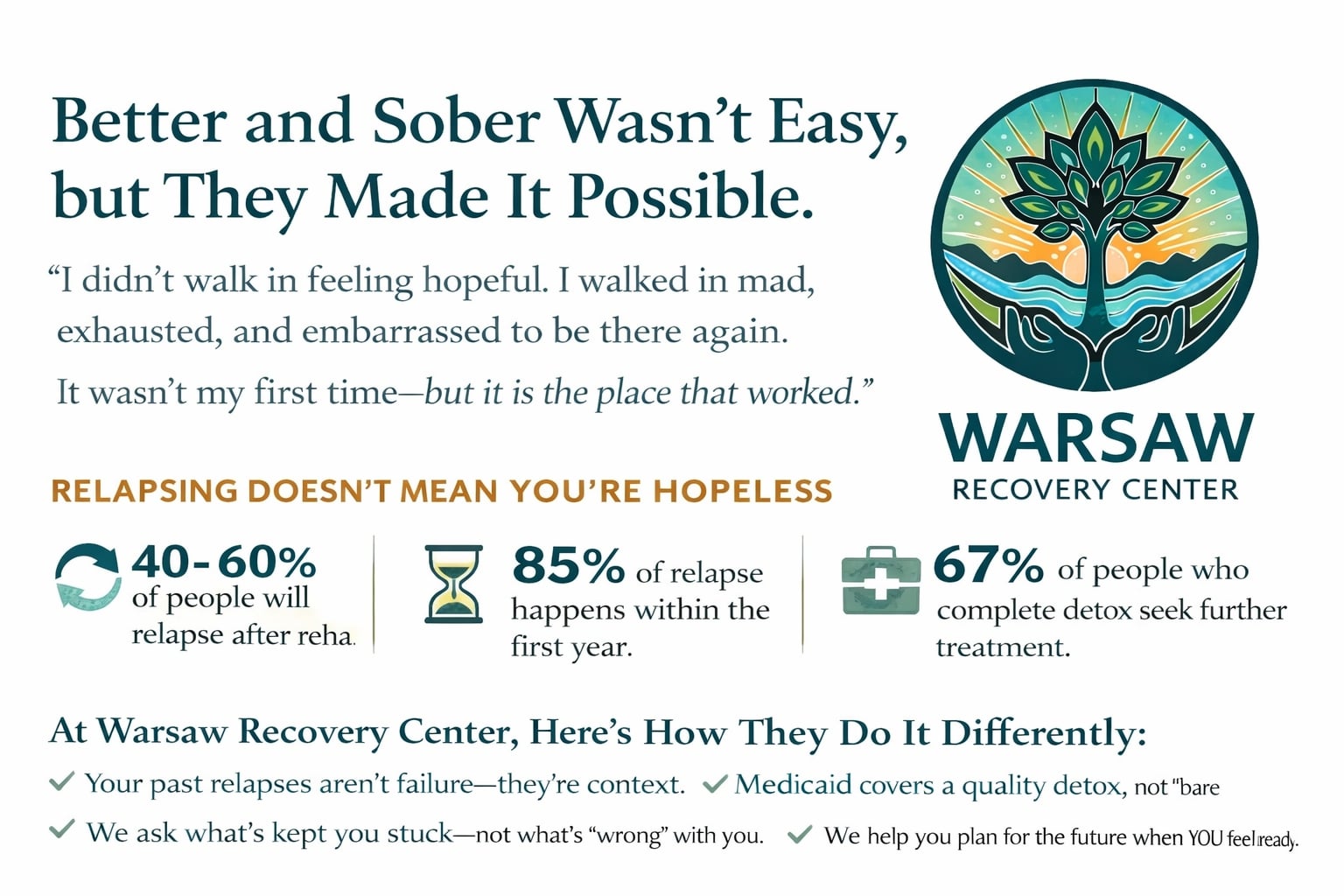
I didn’t walk into treatment hopeful.
I walked in pissed off, tired, and honestly? Embarrassed to be there again.
This wasn’t my first time in a detox program. It wasn’t even my second. I’d done the cycle—show up, sweat it out, get a folder of aftercare referrals I wasn’t ready to follow, and then… go right back.
So when someone told me to check out the drug detox program at Warsaw Recovery Center, I didn’t jump at the chance. I rolled my eyes. Medicaid again? Another round of nurses, meds, and awkward group sessions I didn’t want?
I didn’t believe this time would be different.
But I went anyway—because I was exhausted. Because even though I was over it, I also knew I couldn’t keep waking up to the same hangover, same pit in my stomach, same shame. And somehow, that was enough.
This Time, They Didn’t Pretend I Was Starting Over
One of the worst parts of going back to treatment is how everyone treats you like a beginner. Like you’re brand new to recovery, like your previous attempts didn’t happen—or worse, didn’t count.
At Warsaw, it was different.
The person doing my intake looked at my chart, nodded, and said:
“You already know the language. Let’s figure out why it hasn’t stuck.”
Not “let’s fix you.” Not “let’s get it right this time.” Just: Let’s look at what’s real.
That was the first time I didn’t feel like a failure on day one. I felt like someone who still had a shot.
They Let Me Be Tired—Without Punishment
Most detox centers talk a lot about motivation. They want to know how ready you are. What your goals are. What your plan is after.
At Warsaw, they let me be in the place I actually was—tired, scared, sick, and honestly… not sure I wanted to stay.
And instead of pressuring me to make big commitments, they said, “You don’t have to know what’s next. Let’s just get through the next 12 hours together.”
That was the first promise I could keep.
They Were Honest About What Detox Could (and Couldn’t) Do
Here’s the thing about a good drug detox program: it doesn’t sell you fairy tales.
Detox doesn’t fix trauma. It doesn’t erase cravings forever. It doesn’t make you love your life overnight.
But it can do this:
- Help you sleep without using
- Get food in your body again
- Give you a few moments of peace in your brain
- Remind you that your body is worth taking care of
That’s what Warsaw offered me—not perfection, but a reset. A place to stabilize, not perform.
Medicaid Didn’t Mean “Bare Minimum” Care
I’ve been through places where Medicaid coverage felt like a shortcut to second-class treatment. Quick assessments. No real therapy. Cold attitudes.
Warsaw Recovery Center didn’t treat me like a number.
I got full medical detox services, regular check-ins with the nursing team, and access to meds that actually helped (not just knocked me out). I had a real conversation about medication-assisted treatment options—without pressure, just facts.
There was no “you get what you pay for” energy here. Just care. Actual care.
They Let Me Be Skeptical—and Still Stay
This was the biggest shift.
I didn’t trust the process. I said that on day two. I said it again on day five. I didn’t sugarcoat my doubts about sobriety, recovery, or even myself.
No one tried to talk me out of it. No one handed me slogans. They listened. They kept showing up anyway.
One tech said to me, “You don’t have to be convinced. You just have to stay in the room.” And that’s what I did.
Sometimes, not being pushed is exactly what helps you stay.
They Helped Me Plan for “What’s Next”—When I Was Actually Ready
I didn’t want to talk about aftercare on day one. Or day two. But by day four, I felt a shift. Not a magical awakening—just a soft opening.
They noticed.
Someone sat with me and said, “What feels possible now that didn’t feel possible a few days ago?” Not, “Here’s where you need to go,” but, “What’s one step you might be open to?”
That led to a conversation about outpatient. About staying on MAT for a while. About maybe—maybe—showing up for group again.
It didn’t feel like pressure. It felt like choice.
So What Made It Work This Time?
Not one big thing. Not a breakthrough. Not a “rock bottom.”
Just this:
- They treated my past as experience, not evidence of failure.
- They let me move slowly, without shaming me for it.
- They didn’t sell detox as the solution—just the starting point.
- They held space for my doubt and let me stay anyway.
Maybe most importantly? They didn’t act like my Medicaid status made me any less worthy of real healing.
And for someone like me, who’s been let down before—that made all the difference.
FAQs from People Who’ve Tried Before and Are Still Hurting
Q: What if I’ve already relapsed after rehab—will I be judged?
No. Many people relapse. At Warsaw, we treat your return to care as a sign of courage, not failure.
Q: I don’t believe in the whole recovery system. Should I still try detox?
Yes. You don’t have to believe in the system to deserve care. Detox can offer your body a break, even if your mind isn’t sure yet.
Q: Will I get real therapy in detox, or just meds?
Our detox program includes emotional support and care planning. You’ll have people to talk to, not just medication.
Q: Does Medicaid really cover everything?
Yes—our staff will walk you through what’s included. No surprise bills. No guilt-trips.
Q: What happens after detox if I’m still unsure about treatment?
That’s okay. We help you explore options—without forcing you into anything. Detox is your space to rest, not a trap.
If You’ve Tried and Failed, You’re Not Done
You’re not broken. You’re not out of chances.
You might just need a place that won’t ask you to believe in everything on day one. A place that doesn’t treat relapse like weakness or Medicaid like a limitation.
I found that at Warsaw Recovery Center.
And if you’re still here, reading this? It might be time to try again. Not because you believe in recovery yet—but because maybe, you’re ready to stop believing nothing will work.
That’s where it started for me.
You Deserve a Detox That Doesn’t Feel Like Defeat
Call (888) 511-9480 or visit our drug detox program page to learn how Warsaw Recovery Center does it differently—especially for people who’ve tried before. No pressure. Just possibility.