
You didn’t expect to end up here—questioning whether what once felt like the right level of support is no longer enough.
At first, outpatient care felt like a step forward. There was structure, guidance, a sense that things were moving in the right direction. And maybe, for a while, they were.
But now something feels off again.
For many families in Fredericksburg, Virginia, this realization doesn’t come all at once. It builds slowly—in missed signs, repeated patterns, and the quiet fear that your child is still struggling more than anyone can fully see.
And if you’re feeling that, it doesn’t mean you’ve done anything wrong.
It means you’re paying attention.
The Kind of Progress That Doesn’t Last
There’s a specific kind of heartbreak that comes with “almost better.”
You see glimpses of your child returning to themselves. They engage in sessions. They open up just enough to give you hope. Maybe they even start rebuilding routines.
Then something shifts.
Old behaviors come back. Emotional instability creeps in again. The progress that once felt promising doesn’t seem to stick.
This isn’t uncommon.
Outpatient care works best when someone has enough internal stability to carry what they’re learning back into daily life. But if that foundation isn’t strong yet, the outside world can unravel progress faster than it’s built.
And that’s not a reflection of effort—it’s a reflection of need.
When “Home” Doesn’t Feel Like a Safe Reset
Home is supposed to be the place where healing continues.
But sometimes, it’s where everything gets harder.
Your child may be returning to:
- Stressful relationships
- Unresolved emotional triggers
- Social environments that encourage old habits
- Internal struggles that don’t quiet down after a session ends
You might notice that even after a productive day in treatment, the evening brings a shift—withdrawal, irritability, or behaviors that undo what was just worked on.
This can leave you feeling helpless.
Because you’re trying to create stability—but you can’t control everything they’re facing internally or externally.
You’re Carrying More Than You Let On
Parents rarely talk about this part out loud.
The constant mental scanning. The late-night worry. The emotional exhaustion of holding hope while preparing for setbacks.
You might be asking yourself:
- Am I overreacting?
- Should I give this more time?
- What if I make the wrong decision?
And underneath all of it is something deeper:
I just want them to be okay.
That kind of love is powerful. But it’s also heavy.
And you’re not meant to carry it alone.
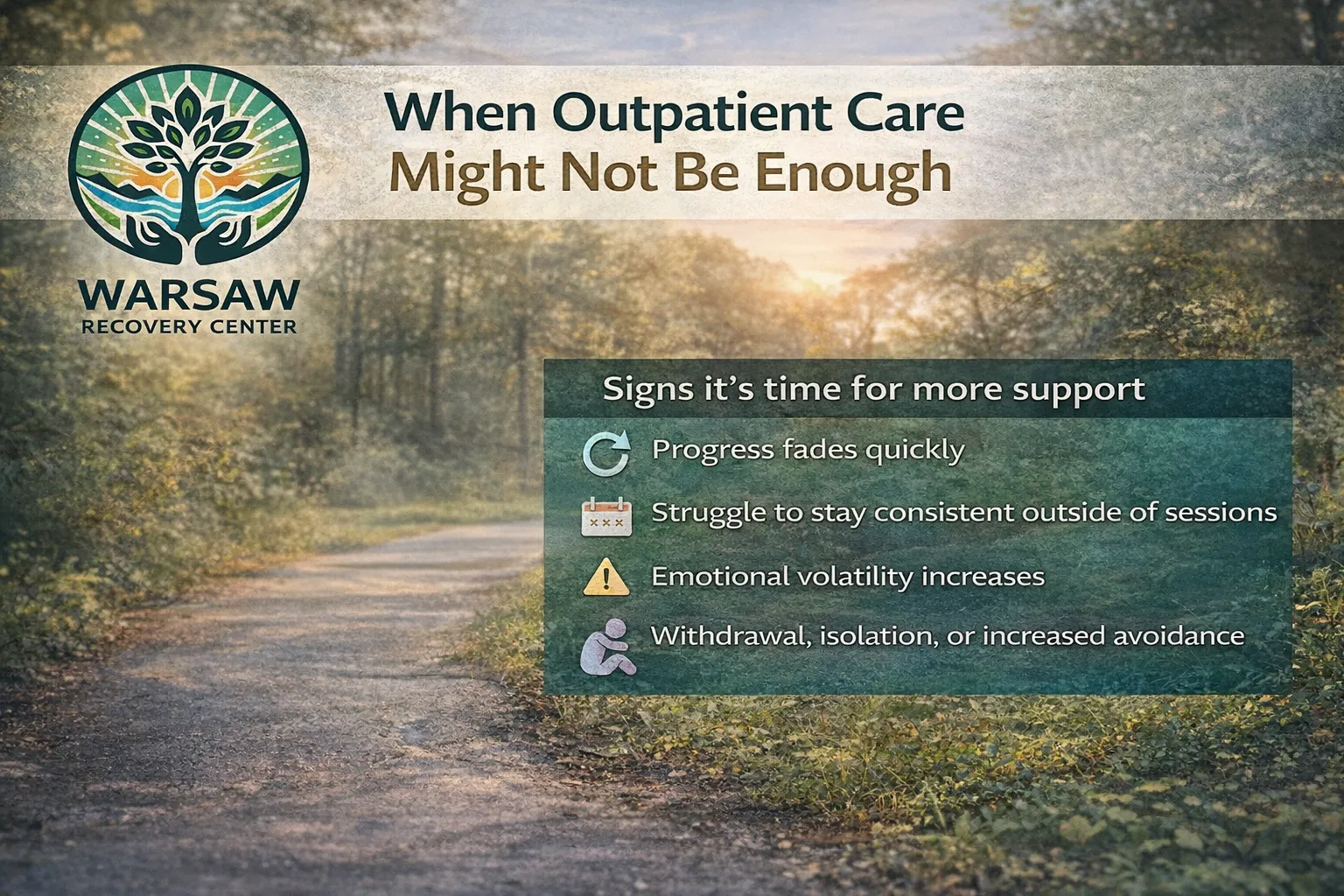
The Signs That It Might Be Time for More Support
There’s no single moment that clearly says, “This is the point where outpatient isn’t enough.”
But there are patterns that begin to form.
You might notice:
- Repeated cycles of improvement followed by regression
- Difficulty maintaining any consistency outside of sessions
- Emotional instability that feels unpredictable or intense
- Ongoing avoidance of deeper issues, even with support
- Increasing withdrawal or isolation
Sometimes, the most telling sign is your own intuition.
That quiet voice that says, this isn’t working the way we hoped it would.
That voice matters.
Why More Structure Can Change the Direction
There are times when healing requires a different environment.
Not because outpatient care failed—but because your child needs more consistency, more support, and more space away from the pressures that keep pulling them back.
In a more immersive setting, support isn’t limited to a few hours a week.
It becomes part of their daily rhythm.
That can mean:
- Immediate guidance during difficult emotional moments
- Fewer external distractions or triggers
- A consistent routine that builds stability over time
- A deeper opportunity to address what’s underneath the surface
For some families, exploring a residential treatment program in Virginia becomes less about escalation—and more about finally creating the conditions where change can actually take hold.
What Parents Often Notice After the Shift
Change doesn’t always come in dramatic breakthroughs.
In fact, it’s often quieter than expected.
Parents begin to notice:
- Their child sleeping more consistently
- Less emotional volatility
- Small moments of openness that weren’t there before
- A gradual sense of stability replacing chaos
One parent described it this way:
“It wasn’t like everything suddenly got better. It was that things stopped falling apart every few days.”
That shift—from crisis to stability—is often where real healing begins.
Letting Go of the Fear of “Too Much”
Many parents hesitate here.
Not because they don’t see the need—but because they’re afraid of what it means.
Is this too much?
Am I overcorrecting?
Will this make things worse somehow?
These questions are valid.
But here’s something to consider:
Choosing a higher level of care isn’t about doing something to your child. It’s about giving them access to a level of support that matches what they’re going through.
It’s not punishment.
It’s not giving up.
It’s not a sign that things are beyond help.
It’s a step toward meeting them where they are.
You’re Allowed to Trust What You’re Seeing
There’s a kind of clarity that comes from being close to someone’s struggle.
You see the patterns others might miss. You feel the shifts that aren’t obvious on the surface.
And even if your child minimizes what they’re going through, your perspective still matters.
You’re not imagining it.
You’re responding to something real.
And trusting that awareness can open the door to better support.
You Don’t Have to Have All the Answers Right Now
This isn’t a decision you have to make overnight.
It’s okay to pause. To ask questions. To learn more before taking the next step.
But you also don’t have to stay stuck in uncertainty.
If you’re beginning to explore options, understanding different levels of care can bring clarity—not pressure.
And sometimes, just having that information can ease a small part of the weight you’ve been carrying.
FAQs
How do I know if outpatient care truly isn’t enough?
Look at patterns over time, not isolated moments.
If progress consistently fades, emotional instability continues, or your child struggles to apply what they’re learning outside of sessions, it may be a sign they need more consistent support.
Will my child feel like they’re being punished?
That’s a common fear.
But the experience often depends on how it’s framed. When presented as support—not consequence—many young adults begin to understand that this step is about helping them, not controlling them.
What if they refuse to go?
Resistance can happen.
It’s important to approach the conversation with honesty, empathy, and clarity—not force. In some cases, involving a professional can help guide that discussion in a way that feels less confrontational.
How long does this type of care usually last?
It varies.
The focus isn’t on a fixed timeline—it’s on progress, stability, and readiness for the next step. Some individuals need more time than others, and that’s okay.
Is it normal to feel unsure about this decision?
Completely.
There’s no easy path here. Feeling uncertain doesn’t mean you’re making the wrong choice—it means you care deeply and want to get it right.
A Final Thought to Hold Onto
There’s no perfect decision. No guaranteed outcome.
But there is something steady beneath all of this:
Your willingness to keep showing up. To keep asking questions. To keep looking for a way forward, even when it’s hard.
If you’re starting to consider whether more support could help, you can explore your options for level of care virginia, residential treatment program virginia through Warsaw Recovery Center.
Call (888) 511-9480 to learn more about our level of care virginia, Residential Treatment Program in Richmond, Virginia.